

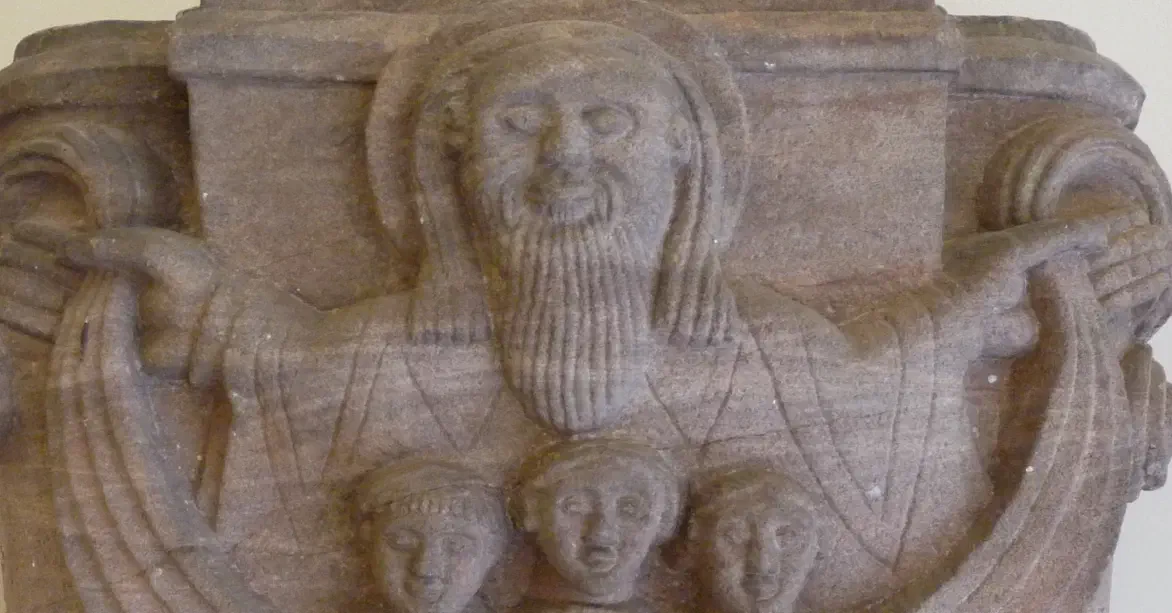
Abraham's bosom emptied when the High Priest died
The law of the cities of refuge ends with a release clause. The manslayer is freed by one event only: the death of the high priest (Numbers 35:25, 28 ); the rabbis stated the reason in legal terms: that death atones. Luke 16 shows the righteous dead in a guarded holding place. Ephesians 4 shows that place emptied when Christ died and ascended. The first is the statute; the second is its execution.

The release clause in Numbers 35
Six cities of refuge (עָרֵי מִקְלָט , arei miklat) received the manslayer, the one who killed without malice. He was guilty of blood but not of murder. Inside the city he was safe from the avenger; outside it, his life was forfeit (Numbers 35:26-27 ). The law fixes the term of confinement:
And the congregation shall deliver the slayer out of the hand of the revenger of blood… and he shall abide in it unto the death of the high priest, which was anointed with the holy oil. Numbers 35:25 KJV
The phrase is עַד־מוֹת הַכֹּהֵן הַגָּדֹל (ad-mot hakohen hagadol), “until the death of the high priest.” Verse 28 adds what the death accomplishes: “after the death of the high priest the slayer shall return into the land of his possession.” Release, and return to the inheritance.
The Talmud states the legal principle directly: it is the death of the high priest that atones for the bloodshed (Makkot 11b). The Mishnah preserves a detail that shows how literally this was taken: the mothers of the high priests supplied food and clothing to the refugees in the cities, so that the refugees would not pray for their sons to die (Makkot 2:6). Every refugee in Israel had a legal interest in the high priest’s death.
The typology has a Jewish witness. John Gill (1748), commenting on Numbers 35:25, cites the Jewish scholar Abendana observing that “the death of the high priest atoned for the offence, which was the reason the manslayer continued in the city of refuge till his death” and draws the conclusion: “the death of Christ, our high priest, atones for every sin of those that flee to him.” Jesus himself read the Torah this way: “as Moses lifted up the serpent in the wilderness, even so must the Son of man be lifted up” (John 3:14 ).
The debt that animal blood deferred
The confinement of the righteous dead follows from three facts.
The soul survives the body. “And fear not them which kill the body, but are not able to kill the soul” (Matthew 10:28 ). The person outlives the flesh; the same verse locates the soul’s destruction at a later judgment, not at the grave.
Guilt precedes the act. “Behold, I was shapen in iniquity; and in sin did my mother conceive me” (Psalm 51:5 ). “As by one man sin entered into the world, and death by sin; and so death passed upon all men” (Romans 5:12 ). A man sins because he is a sinner from birth. The standing is inherited before the first act is committed, like the manslayer’s status: guilt without malice.
Sacrifice covered known sins; the account stayed open. The sin offering required knowledge of the sin (Leviticus 4:23, 28 : “if his sin… come to his knowledge”). Leviticus 5:17 states that the one who sins without knowing it “is guilty” nonetheless. David asks, “Who can understand his errors? cleanse thou me from secret faults” (Psalm 19:12 ). Job offered burnt offerings for his sons on the mere possibility of sin: “It may be that my sons have sinned” (Job 1:5 ). Abraham could atone for his last known sin with a lamb; no lamb could certify that the account was closed.
The New Testament states what those sacrifices actually did:
For it is not possible that the blood of bulls and of goats should take away sins. Hebrews 10:4 KJV
Romans 3:25 uses a precise word for God’s handling of pre-cross sin: the πάρεσις (paresis) “of sins that are past”, a passing-over, a deferral, not the ἄφεσις (aphesis) of removal. The word occurs only here in the New Testament. And Hebrews 9:15 states which direction the cross paid: Christ died “for the redemption of the transgressions that were under the first testament.” His death settled debts contracted under the old covenant: the debts of the people already dead.
The righteous dead were therefore exactly what the manslayer was: persons whose guilt carried no malice, safe from the avenger, at peace, and lawfully confined, because the death that closes the account had not yet occurred.
Abraham’s bosom on the Second Temple map
And it came to pass, that the beggar died, and was carried by the angels into Abraham’s bosom (τὸν κόλπον Ἀβραάμ )… And beside all this, between us and you there is a great gulf fixed (χάσμα μέγα ἐστήρικται ): so that they which would pass from hence to you cannot. Luke 16:22, 26 KJV
Both the rich man and Lazarus are dead, conscious, and in the same underworld, hades, separated into two conditions by a fixed gulf (see Sheol, Hades, Hell, Gehenna for the four terms). The geography is the standard Second Temple map:
- 1 Enoch 22 describes the mountain of the dead with separate hollow places: one for the righteous, with a bright spring of water, and others for the wicked awaiting judgment. Separation before resurrection.
- 4 Ezra 7:95 has the souls of the righteous “gathered into their chambers and guarded by angels in profound quiet” until the last days.
- 4 Maccabees 13:17: the seven martyred brothers expect at death: “Abraham and Isaac and Jacob will welcome us, and all the fathers will praise us.” Three verses earlier runs the parallel to Matthew 10:28 (4 Maccabees 13:14): “Let us not fear him who thinks he is killing us.”
- Kiddushin 72b uses “today he sits in Abraham’s bosom” (הַיּוֹם יוֹשֵׁב בְּחֵיקוֹ שֶׁל אַבְרָהָם ), in that passage of an infant just circumcised, entering Abraham’s covenant. The idiom marks belonging to Abraham’s care; it was stock language, not a coinage of Jesus.
Jesus told the story onto a map his audience already used. The apostles then testify where the occupants were:
| Figure | Text | Location stated |
|---|---|---|
| Jacob | Genesis 37:35 | “I will go down into the grave (sheol) unto my son” |
| Job | Job 14:13 | “O that thou wouldest hide me in the grave (sheol)… until thy wrath be past” |
| Samuel | 1 Samuel 28:13-15 | The medium sees “gods (אֱלֹהִים , elohim) ascending out of the earth”; Samuel asks, “why hast thou disquieted me, to bring me up?” |
| Hezekiah | Isaiah 38:10 | Expected “the gates of the grave (sheol)” |
| Lazarus, Abraham | Luke 16:22-26 | Abraham’s bosom, across a fixed gulf, within sight of hades’ torment side |
| David | Acts 2:29, 34 | “His sepulchre is with us unto this day… David is not ascended into the heavens” |
| Everyone | John 3:13 | “No man hath ascended up to heaven” |
Hebrews gives the architectural reason. While the first tabernacle stood, “the way into the holiest of all was not yet made manifest” (Hebrews 9:8 ). And of the faithful dead: “these all, having obtained a good report through faith, received not the promise: God having provided some better thing for us, that they without us should not be made perfect” (Hebrews 11:39-40 ).
The one the grave could not hold
Jesus, the Son of man, was fully human. He grew (Luke 2:52 ), and “though he were a Son, yet learned he obedience by the things which he suffered; and being made perfect, he became the author of eternal salvation” (Hebrews 5:8-9 ). The text itself describes a completed course (being made perfect) walked in flesh.
One thing he did not share: the inherited standing. Descent, and the guilt attached to it, is reckoned through the man: “by one man sin entered into the world” (Romans 5:12). Jesus is the seed of the woman (Genesis 3:15 ), the only person in Scripture so designated; no human father planted seed, so no line from Adam conveyed the debt (see the virgin birth was not optional for the legal genealogy). Born without the standing, living without the act, he owed death nothing.
Which is why death could not keep him:
Whom God hath raised up, having loosed the pains of death: because it was not possible that he should be holden of it. … Because thou wilt not leave my soul in hell (ᾅδης ), neither wilt thou suffer thine Holy One to see corruption. Acts 2:24, 27 KJV , quoting Psalm 16:10 (שְׁאוֹל , sheol)
The KJV’s rendering of this verse, “thou wilt not leave my soul in hell”, is the source of the pulpit line that Jesus was in hell. In the KJV’s vocabulary the statement is correct: the word is ᾅδης , the holding place of the dead, the same realm that contains Abraham’s bosom, not gehenna, the lake-of-fire judgment. One English word carries three different terms in the KJV, and the old creedal phrase “descended into hell” means hades in exactly this sense. The four terms are laid out in Sheol, Hades, Hell, Gehenna.
“Not possible” is a legal statement. Hades had no claim to enforce. He entered it anyway, “today shalt thou be with me in paradise” (Luke 23:43 ), as the anointed High Priest whose death is, by the statute of Numbers 35, the release of everyone held inside. He laid his life down with authority to take it again (John 10:18 ).
The release
Wherefore he saith, When he ascended up on high, he led captivity captive (ᾐχμαλώτευσεν αἰχμαλωσίαν ), and gave gifts unto men. (Now that he ascended, what is it but that he also descended first into the lower parts of the earth?) Ephesians 4:8-9 KJV
The sequence is explicit: descent to the lower parts, then ascent with a train of freed captives. Matthew records the visible edge of the event: at the crucifixion “the graves were opened; and many bodies of the saints which slept arose, and came out of the graves after his resurrection, and went into the holy city, and appeared unto many” (Matthew 27:52-53 ). The timing note (after his resurrection) keeps the legal order: the High Priest dies, is raised, and only then do the released walk out.
Hebrews describes what the release dissolved:
That through death he might destroy him that had the power of death, that is, the devil; and deliver them who through fear of death were all their lifetime subject to bondage. Hebrews 2:14-15 KJV
Fear of death is the oldest chain in the book. The first recorded fear follows the first sin: “I heard thy voice in the garden, and I was afraid” (Genesis 3:10 ), the first mention setting the pattern. The bondage that began in the garden is the bondage the High Priest’s death ends.
After the event, paradise changes address. In Luke 16 the refuge is down, across a gulf, within hades. When Paul mentions paradise, he locates it in the third heaven, up (2 Corinthians 12:2-4 ). The refuge city was decommissioned because its statute had fired: “after the death of the high priest the slayer shall return into the land of his possession” (Numbers 35:28 ), and Hebrews calls what the freed receive “the promise of eternal inheritance” (Hebrews 9:15).
Standing in the presence is granted
The compartmentalization of the bosom raises the obvious question of why the righteous dead, comforted and at rest, were not simply in heaven. The answer runs through the spiritual realm’s own structure: access to the presence of God is a granted standing, never a function of sinlessness.
The vocabulary keeps the two ideas apart. אֱלֹהִים (elohim) names what a being is: a resident of the spiritual realm (see the Deuteronomy 32 worldview). מַלְאָךְ (mal’akh) / ἄγγελος (angelos) names what a being does: messenger. A job title, not a species. The category is wide enough to include the human dead: the medium at Endor reports “gods (elohim) ascending out of the earth”, and what came up was Samuel (1 Samuel 28:13-14). Ben Sira, writing around 180 BC, read the scene the same way: “And after his death he prophesied, and shewed the king his end, and lifted up his voice from the earth in prophecy” (Sirach 46:20), a dead prophet speaking from below, not from heaven. The loyal elohim, those who did not rebel, are without sin. Yet the texts do not give them uniform access.
Gabriel opens his commission to Zacharias not with his name alone but with his credential:
I am Gabriel, that stand in the presence of God (ὁ παρεστηκὼς ἐνώπιον τοῦ θεοῦ ); and am sent to speak unto thee. Luke 1:19 KJV
The standing authorizes the message. Three independent Second Temple witnesses know a fixed class holding that standing: Raphael calls himself “one of the seven holy angels… which go in and out before the glory of the Holy One” (Tobit 12:15); 1 Enoch 20 lists the seven by name; Revelation 8:2 refers to “the seven angels which stood before God”: definite article, a known class. Matthew 18:10 shows access assigned beyond the seven to a specific watch (“their angels do always behold the face of my Father”); the point is that access is assigned at all.
The structure is delegation from a throne outward. Micaiah sees it operating in 1 Kings 22:19-22 : a throne, a council, a volunteer, a commission. The same architecture runs through Jesus’ ministry: the three (Mark 9:2 ), the twelve given “power and authority over all devils” (Luke 9:1 ), the seventy sent with his name (Luke 10:1, 17 ).
Authority in this structure attaches to standing, not to merit. The seventy return reporting “even the devils are subject unto us through thy name” (Luke 10:17), and the church is seated with Christ “far above all principality, and power, and might, and dominion” (Ephesians 1:21 ; 2:6 ), a standing above every ranked power, held entirely by delegation.
This is why the bosom’s occupants were where they were. What they lacked was standing before the throne, a standing that, on the evidence above, most of the sinless loyal elohim never held either. The presence had been closed to man since Eden, and closed by an assigned guard: “he placed at the east of the garden of Eden cherubims… to keep the way of the tree of life” (Genesis 3:24 ). Hebrews announces the counterpart: “boldness to enter into the holiest by the blood of Jesus, by a new and living way, which he hath consecrated for us, through the veil, that is to say, his flesh” (Hebrews 10:19-20 ).
The end state inverts the entire arrangement. John sees “a great multitude, which no man could number… before the throne… and serve him day and night in his temple” (Revelation 7:9, 15 ). Redeemed humans hold, as a numberless crowd, the standing that a class of seven held in the old court, “which things the angels desire to look into” (1 Peter 1:12 ).
The objection: a High Priest who never dies
The standard reading of the type runs the other way: the believer stays in the refuge forever because the true High Priest never dies (Hebrews 7:23-25 ). The objection dissolves in the same chapter. This High Priest “offered up himself”: “this he did once” (Hebrews 7:27 ). The death the statute requires happened, once, at a fixed point in history. The endless priesthood is resurrection-side: he holds it “after the power of an endless life” (Hebrews 7:16 ), which is the power demonstrated by walking out of hades. The release clause fired at the cross; the everlasting priesthood guarantees it never needs to fire again.
The epistle itself joins the two halves of the type in three verses. Believers are those “who have fled for refuge (οἱ καταφυγόντες ) to lay hold upon the hope set before us”, and the hope enters “within the veil; whither the forerunner is for us entered, even Jesus, made an high priest for ever after the order of Melchisedec” (Hebrews 6:18-20 ; on the order, see Melchizedek). Refuge language and high-priest language, fused by the author of Hebrews, about the same event.
References
- Mishnah, Makkot 2:6: the mothers of the high priests provisioning the refugees in the cities of refuge.
- Babylonian Talmud, Makkot 11b: “It is the death of the High Priest that atones.”
- 4 Maccabees 13:14, 17: the fear-not-killing parallel to Matthew 10:28; “Abraham and Isaac and Jacob will welcome us, and all the fathers will praise us.”
- Babylonian Talmud, Kiddushin 72b: “today he sits in Abraham’s bosom”, stock idiom of belonging to Abraham, in that passage of an infant at circumcision.
- 1 Enoch 22 (tr. Charles): the hollow places of the dead, the righteous separated with a bright spring of water.
- 4 Ezra (2 Esdras) 7:95: the souls of the righteous “gathered into their chambers and guarded by angels in profound quiet.”
- John Gill, Exposition of the Old Testament (1748), on Numbers 35:25: citing Abendana on the high priest’s death atoning, and the application to Christ.
- Tobit 12:15: “I am Raphael, one of the seven holy angels, which present the prayers of the saints, and which go in and out before the glory of the Holy One.”
- 1 Enoch 20 (tr. Charles): the seven holy angels who watch, listed by name.
- Sirach (Ecclesiasticus) 46:20: Samuel prophesying after death, lifting up his voice from the earth.