

The first and last letters of the Bible spell Son in Hebrew
The Bible uses structural formatting at every scale. Chiasm highlights the center of a passage. Inclusio marks the boundaries. Equidistant letter sequences in the Torah encode its own name and point inward to YHVH. The first and last letters of the entire canon, Bet and Nun, spell בן (Ben): Son in Hebrew.

Chiasm
A chiasm is a literary structure where elements mirror each other around a central point. The pattern runs A-B-C-B’-A’. The center (C) carries the weight. Ancient authors used chiasm the way modern authors use bold text or headings: to direct the reader’s attention. The Bible uses this structure from individual verses to entire books to the canon itself.
The Torah chiasm
Rabbi Michael Dov Ber Weissmandl (1903-1957) discovered that the Torah encodes its own name in equidistant letter sequences. Starting from the first Tav (ת ) in Genesis and counting every 50th letter spells תורה (Torah). The same pattern appears in Exodus. In Numbers and Deuteronomy, the same sequence runs in reverse: הרות .
The skip count is 49 (7 × 7, completeness squared). The encoded letter falls on every 50th position, the number of Jubilee (Leviticus 25:10 ). The Torah’s hidden structure uses the same numbers the Torah itself assigns meaning to.
The four outer books point inward. At the center, Leviticus, the pattern changes. Starting from the first Yod (י ) and counting every 8th letter spells יהוה (YHVH), the name of God.
| Book | Direction | Sequence | |
|---|---|---|---|
| 1 | Genesis | → | תורה (Torah) |
| 2 | Exodus | → | תורה (Torah) |
| 3 | Leviticus | center | יהוה (YHVH) |
| 4 | Numbers | ← | הרות (Torah reversed) |
| 5 | Deuteronomy | ← | הרות (Torah reversed) |
The Torah points to God’s name at its center. Weissmandl’s findings were published posthumously in Torat Chemed (1958). The author independently verified the pattern in the Leningrad Codex.
A chiasm inside a chiasm
Leviticus, the center book of the Torah and the book that spells YHVH, is itself chiastic:
- Chapters 1-7 and 23-27: Ritual
- Chapters 8-10 and 21-22: Priesthood
- Chapters 11-15 and 18-20: Purity
- Chapters 16-17: The Day of Atonement
The Torah points to YHVH. YHVH’s book points to the Day of Atonement. The resolution of the chiasm inside the chiasm is atonement.
The center of the Bible
The King James Bible contains 31,102 verses. With an even total, two verses share the center: Psalm 103:1 and Psalm 103:2 (verses 15,551 and 15,552).
Bless the LORD, O my soul: and all that is within me, bless his holy name. Bless the LORD, O my soul, and forget not all his benefits: Psalm 103:1-2 KJV
Both verses open with the same words: “Bless the LORD, O my soul.” Whether the total count is 31,102 or 31,101 (if John 6:4 is a later scribal insertion), the center falls on the same phrase.
The Bible contains 1,189 chapters. The middle chapter is Psalm 117, also the shortest chapter in the Bible at two verses:
O praise the LORD, all ye nations: praise him, all ye people. For his merciful kindness is great toward us: and the truth of the LORD endureth for ever. Praise ye the LORD. Psalm 117:1-2 KJV
The center verses are praise. The center chapter is praise. The chiasm holds at both scales.
Inclusio
An inclusio is a literary bracket. Ancient authors placed the same word, name, or phrase at the beginning and end of a section to mark its boundaries and identify its source. Where modern documents have title pages and bylines, ancient texts had inclusio.
The Petrine inclusio in Mark
Richard Bauckham (Jesus and the Eyewitnesses, 2006) identified a Petrine inclusio in the Gospel of Mark. Peter is the first disciple named (Mark 1:16 ) and the last (Mark 16:7 ). The Gospel opens and closes with Peter, marking him as the eyewitness source behind the text.
In the earliest Greek manuscripts, Mark 1:16 names Simon twice in a single verse:
Καὶ παράγων παρὰ τὴν θάλασσαν τῆς Γαλιλαίας εἶδεν Σίμωνα καὶ Ἀνδρέαν τὸν ἀδελφὸν Σίμωνος ἀμφιβάλλοντας ἐν τῇ θαλάσσῃ· ἦσαν γὰρ ἁλιεῖς“And passing along the Sea of Galilee, he saw Simon and Andrew the brother of Simon, casting a net into the sea, for they were fishermen.”
The Textus Receptus reads τὸν ἀδελφὸν αὐτοῦ (“his brother”), replacing the second Simon with a pronoun. The earlier manuscripts preserve the double naming. The inclusio is visible in both readings at the macro level (Peter is the first and last disciple named in Mark), but the redundant naming in Mark 1:16 is only visible in the earlier Greek text.
Papias of Hierapolis (early 2nd century, preserved in Eusebius, Church History 3.39.15) confirms the connection independently: Mark was Peter’s hermeneutes (ἑρμηνευτής , interpreter) in Rome. Peter preached his eyewitness account in Aramaic. Mark rendered it into Greek for an international audience. The inclusio marks Peter as the source. Papias names him as the source. The structural evidence and the historical testimony converge.
The Aleph-Tav in Genesis 1:1
Genesis 1:1 contains seven Hebrew words. The word אֵת (et), composed of Aleph (א , first letter) and Tav (ת , last letter), appears twice: as word 4 and within word 6. The same 4-6 division appears in the Ten Commandments, where the two tablets split into 4 words addressing God and 6 addressing man. The Hebrew term for the commandments is עֲשֶׂרֶת הַדְּבָרִים (aseret hadevarim), the ten words. Jesus is identified as the Word (John 1:1 ).
| # | Hebrew | Transliteration | Meaning |
|---|---|---|---|
| 1 | בְּרֵאשִׁית | bereshit | in the beginning |
| 2 | בָּרָא | bara | created |
| 3 | אֱלֹהִים | Elohim | God |
| 4 | אֵת | et | (direct object marker) |
| 5 | הַשָּׁמַיִם | hashamayim | the heavens |
| 6 | וְאֵת | ve’et | and (direct object marker) |
| 7 | הָאָרֶץ | ha’aretz | the earth |
English translations omit אֵת because it functions as a grammatical particle with no English equivalent. It marks a definite direct object. In Genesis 1:1, it connects the subject (God) to the object (the heavens and the earth).
God identifies himself as Elohim in this verse. Adam and Eve knew no other gods. The name was sufficient. The Aleph-Tav brackets the object of creation twice in the same sentence: an inclusio. The author signed the first verse with the first and last letters of the Hebrew alphabet.
Alpha and Omega
In Revelation, the same claim appears in Greek.
I am Alpha and Omega, the beginning and the ending, saith the Lord, which is, and which was, and which is to come, the Almighty. Revelation 1:8 KJV
I am Alpha and Omega, the beginning and the end. Revelation 21:6 KJV
I am Alpha and Omega, the beginning and the end, the first and the last. Revelation 22:13 KJV
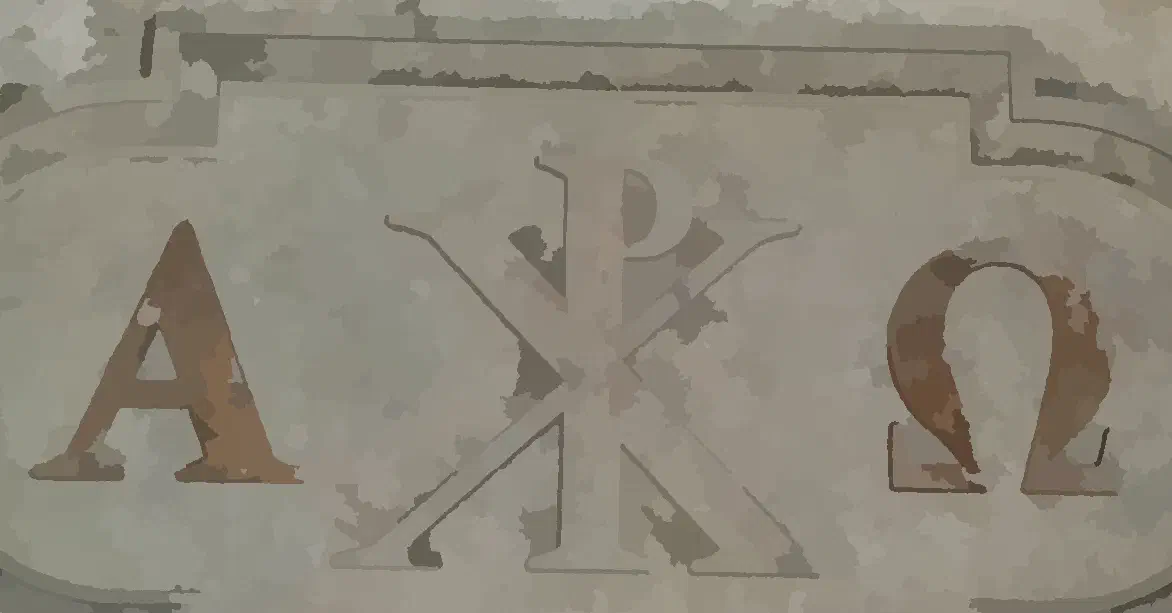
τὸ Ἄλφα καὶ τὸ Ὦ (to Alpha kai to O, “the Alpha and the Omega”) uses the first and last letters of the Greek alphabet. The Hebrew equivalent is Aleph and Tav. The speaker is identified as Jesus in context (Revelation 22:16 ).
Genesis opens with the Aleph-Tav. Revelation closes with the Alpha-Omega. The canon itself forms a chiasm bracketed by an inclusio: the first and last letters of both biblical languages, Hebrew at the beginning, Greek at the end.
The first and last letters
The first word of the Bible is בְּרֵאשִׁית (bereshit, “in the beginning”). Its first letter is Bet (ב ).
The last word of the Bible is ἀμήν (amen), a Hebrew word preserved unchanged in the Greek text of Revelation 22:21 . Its last letter is Nun (נ ).
ב + נ = בן
Ben. Son.
The first and last letters of the entire Bible spell Son in Hebrew.
References
- Rabbi Michael Dov Ber Weissmandl, Torat Chemed (1958): equidistant letter sequences in the Torah. Published posthumously by his students.
- Richard Bauckham, Jesus and the Eyewitnesses: The Gospels as Eyewitness Testimony (2006): Petrine inclusio in the Gospel of Mark.
- Papias of Hierapolis (early 2nd century), preserved in Eusebius, Church History 3.39.15: Mark as Peter’s interpreter in Rome.