

Dating the birth of Christ from Luke's own timeline
Luke builds a timeline. Zechariah serves in the course of Abijah, the eighth priestly division. He goes home. Elisabeth conceives. Six months into her pregnancy, Mary conceives. Nine months later, Jesus is born. Every step is documented with verses. The chain places the birth in late September, not December.

Luke’s method
Luke 1:1-4 states his methodology upfront. He investigated “all things from the very first” and compiled his account from eyewitness testimony. This is a researched document with a specific recipient (Theophilus) and a stated goal: certainty.
Galatians 4:4 : “But when the fulness of the time was come, God sent forth his Son, made of a woman, made under the law.” The timing was precise.
Zechariah and the course of Abijah
Luke 1:5-10 introduces Zechariah, a priest “of the course of Abia” (Abijah), and his wife Elisabeth.
Luke 1:8 : “while he executed the priest’s office before God in the order of his course.”
David divided the priestly duties into 24 courses (1 Chronicles 24:2-4 ). The course of Abijah is the eighth (1 Chronicles 24:10 ).
The priestly year begins at Passover. Exodus 12:2 : “This month shall be unto you the beginning of months: it shall be the first month of the year to you.” Exodus 13:3-4 identifies this month as Abib (later called Nisan, March/April). Leviticus 23:5 fixes the date: “In the fourteenth day of the first month at even is the LORD’s passover.”
The first course begins service after Passover. The eighth course, Abijah, serves approximately two months into the cycle, placing Zechariah’s service around Sivan (May/June).
The timeline from conception to birth
Luke 1:11-17 : The angel Gabriel appears to Zechariah during his service and announces that Elisabeth will bear a son.
Luke 1:18-22 : Zechariah doubts and is struck mute. He remains serving at the temple unable to speak.
Luke 1:23-25 : “And it came to pass, that, as soon as the days of his ministration were accomplished, he departed to his own house. And after those days his wife Elisabeth conceived.” Elisabeth conceives shortly after Zechariah returns home, approximately June.
Luke 1:26-38 : “And in the sixth month the angel Gabriel was sent from God unto a city of Galilee, named Nazareth.” Six months into Elisabeth’s pregnancy, Gabriel visits Mary. Six months after June is approximately late December. Mary conceives.
Luke 1:39-56 : Mary visits Elisabeth and stays about three months.
Luke 1:57-60 : “Now Elisabeth’s full time came that she should be delivered; and she brought forth a son.” John is born approximately nine months after June, in late March.
Luke 2:6-7 : “And so it was, that, while they were there, the days were accomplished that she should be delivered. And she brought forth her firstborn son.” Jesus is born nine months after late December, approximately late September.
| Event | Approximate timing |
|---|---|
| Zechariah serves (course of Abijah) | May/June |
| Elisabeth conceives | June |
| Gabriel visits Mary (Elisabeth’s 6th month) | Late December |
| Mary conceives | Late December |
| John born | Late March |
| Jesus born | Late September |
Late September and the Feast of Tabernacles
Late September falls in the Hebrew month of Tishri. The Feast of Tabernacles, Sukkot (סֻכּוֹת , “booths”), begins on Tishri 15. Sukkot celebrates God dwelling with his people. For seven days Israel lives in temporary shelters to remember the wilderness period when God’s presence traveled with them.
John 1:14 : καὶ ὁ λόγος σὰρξ ἐγένετο καὶ ἐσκήνωσεν ἐν ἡμῖν (“and the Word became flesh and tabernacled among us”). John did not write “he lived among us.” He chose ἐσκήνωσεν (eskenosen), from σκηνή (skene, “tent, tabernacle”), the same root used throughout the Septuagint for the wilderness tabernacle. If Jesus was born during Sukkot, John’s verb is a precise statement, not a metaphor: God pitched his tent in human flesh on the feast that celebrates God pitching his tent among his people.
Zechariah 14:16-19 makes Sukkot the only feast the nations must observe in the messianic age. If the first coming occurred on the feast that celebrates God’s arrival among his people, and the messianic age requires all nations to keep the same feast, the pattern is complete.
The timeline in Luke does not pinpoint an exact day. It points to late September. Sukkot falls in late September. The connection is where the data lands.
The firstborn and the purification
Luke 2:21 : “And when eight days were accomplished for the circumcising of the child, his name was called JESUS.”
Leviticus 12:1-8 prescribes the purification period after childbirth: 40 days for a male child. Luke 2:22 records that “when the days of her purification according to the law of Moses were accomplished, they brought him to Jerusalem, to present him to the Lord.”
Luke 2:24 notes the offering: “A pair of turtledoves, or two young pigeons.” This is the offering prescribed for those who cannot afford a lamb (Leviticus 12:8 ). Mary and Joseph were poor.
The inn that was not an inn
Luke 2:7 : “there was no room for them in the inn.” The KJV translates the Greek κατάλυμα (kataluma) as “inn.” But Luke knows the Greek word for a commercial inn. He uses πανδοχεῖον (pandocheion) in Luke 10:34 , the parable of the Good Samaritan, where the man is brought to an actual inn with an innkeeper. He chose a different word for the birth narrative.
Kataluma means a guest room. It is the same word Luke uses in 22:11 for the upper room of the Last Supper: “Where is the guestchamber (kataluma), where I shall eat the passover with my disciples?” The KJV translates the same Greek word as “inn” in chapter 2 and “guestchamber” in chapter 22.
First-century Judean homes had a raised main living area with a lower section at the entrance where animals were brought in at night. The manger, a feeding trough, was built into the step between the two levels. This was the ground floor of the family home, not a separate barn or stable. Wealthier homes had a guest room (kataluma) attached to or above the main room.
Archaeological excavations of first-century homes in Bethlehem confirm this layout. The house design persisted in the region for centuries. The kataluma was a guest room in a private home, not a commercial lodging.
The picture changes entirely. Joseph brought his pregnant wife to his ancestral town, to the home of relatives. The guest room was already occupied. The birth took place in the main room of the house, where the manger was. Mary laid the baby in a feeding trough that was part of the family living space. She was in a home, surrounded by family, in the one spot where a stone trough could serve as a cradle.
The wise men came later
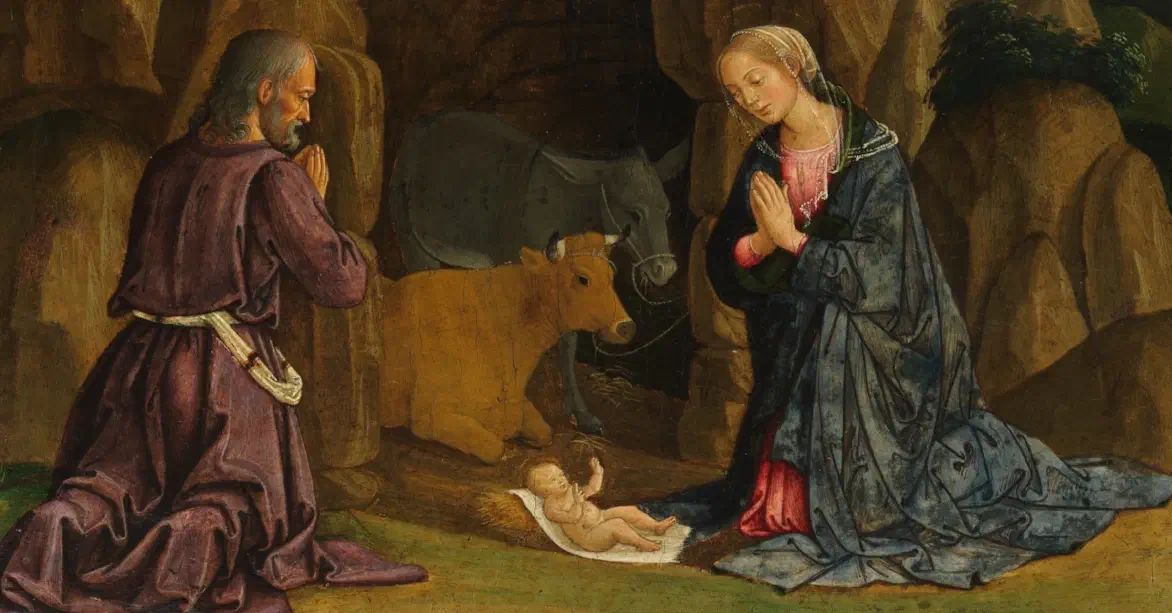
The traditional nativity scene places shepherds and wise men together at the manger on the night of the birth. The familiar scene with three kings kneeling beside shepherds at a manger comes from centuries of artistic tradition, not from Matthew or Luke. The two accounts describe events separated by a significant period of time.
Matthew 2:11 : “And when they were come into the house, they saw the young child with Mary his mother.” The Greek is οἰκίαν (oikian, “house”), not a stable or a cave. The family had moved from the manger to a house by the time the wise men arrived.
The Greek word for the child in Matthew 2:11 is παιδίον (paidion), which refers to a young child or toddler. Luke uses βρέφος (brephos, “newborn, infant”) for the baby in the manger (Luke 2:12 ). Matthew uses a different word because Jesus was no longer a newborn.
Herod ordered the killing of all children “from two years old and under, according to the time which he had diligently inquired of the wise men” (Matthew 2:16 ). If Jesus were a newborn, killing children up to two years old would be excessive. The age range confirms that significant time had passed between the birth and the arrival of the wise men, approximately one year or more.
How the magi knew
The Greek μάγοι (magoi) is a Persian term for the priestly-scholarly caste of Babylon and Persia. Matthew 2:1 says they came “from the east.” Babylon is east of Jerusalem.
Daniel held the title “master of the magicians” in Babylon (Daniel 5:11 ). Nebuchadnezzar made him “chief of the governors over all the wise men of Babylon” (Daniel 2:48 ). Daniel was head of the magoi.
Daniel also received and recorded a specific messianic timeline. Daniel 9:25 : “from the going forth of the commandment to restore and to build Jerusalem unto the Messiah the Prince shall be seven weeks, and threescore and two weeks.” The prophecy gave a countdown.
The magoi were a hereditary caste. Knowledge passed from generation to generation. Daniel’s writings, including his messianic prophecies, would have been preserved in the archives of the institution he led. Centuries later, magoi from the same eastern region arrive in Jerusalem asking “Where is he that is born King of the Jews? for we have seen his star in the east, and are come to worship him” (Matthew 2:2 ).
They knew to look. They knew when. They knew it was a king. The text connects Daniel’s position over the magoi directly to the magoi who arrived looking for the Messiah.
References
- Kenneth Bailey (40 years of fieldwork and excavation in the Middle East), Jesus Through Middle Eastern Eyes: kataluma as family guestroom, first-century Judean home layout with ground-floor manger.
- Chronography of 354 AD, Depositio Martyrum: earliest known documentary source placing the birth of Christ on December 25.