

God made Moses a god to Pharaoh, and the same authority is delegated to the believer
God delegates his authority to men, and the Exodus is the demonstration: “See, I have made thee a god to Pharaoh” (Exodus 7:1 ), and through that one man God judged every god Egypt had (Exodus 12:12 ). The same structure governs the New Testament: all authority is given to Jesus, and from him it is handed to the believer (Matthew 28:18 ; Luke 9:1 ; 10:19 ). No elohim, in Egypt or since, outranks the one who walks in the authority of God. The boundary is the delegation itself: the sons of Sceva spoke the name without it and were overpowered (Acts 19:13-16 ).

A god to Pharaoh
The confrontation is framed before it begins: Moses will be to Aaron “instead of God” (Exodus 4:16 ), and on the way into Egypt, “See, I have made thee a god to Pharaoh: and Aaron thy brother shall be thy prophet” (Exodus 7:1). The word is elohim (אֱלֹהִים , “God, gods”), the Bible’s category word for the inhabitants of the spiritual realm: used for the God of Israel, for council members, for idols, and here for one obedient man (see the names of God). The delegation mirrors God’s own order: a man made elohim to Pharaoh, with a prophet the way God has prophets.
The mission names the class of being the authority is aimed at: “against all the gods of Egypt I will execute judgment” (Exodus 12:12), recorded done: “upon their gods also the LORD executed judgments” (Numbers 33:4 ). The first sign carries the same scale. At the bush the rod became a nachash (נָחָשׁ , “serpent”) (Exodus 4:3 ), the serpent word of Genesis 3; before Pharaoh the word changes to tannin (תַּנִּין , “dragon”), the word Ezekiel uses when he calls Pharaoh “the great dragon that lieth in the midst of his rivers” (Ezekiel 29:3 ). The magicians’ rods become dragons too, “but Aaron’s rod swallowed up their rods” (Exodus 7:12 ).
The name with no god in it
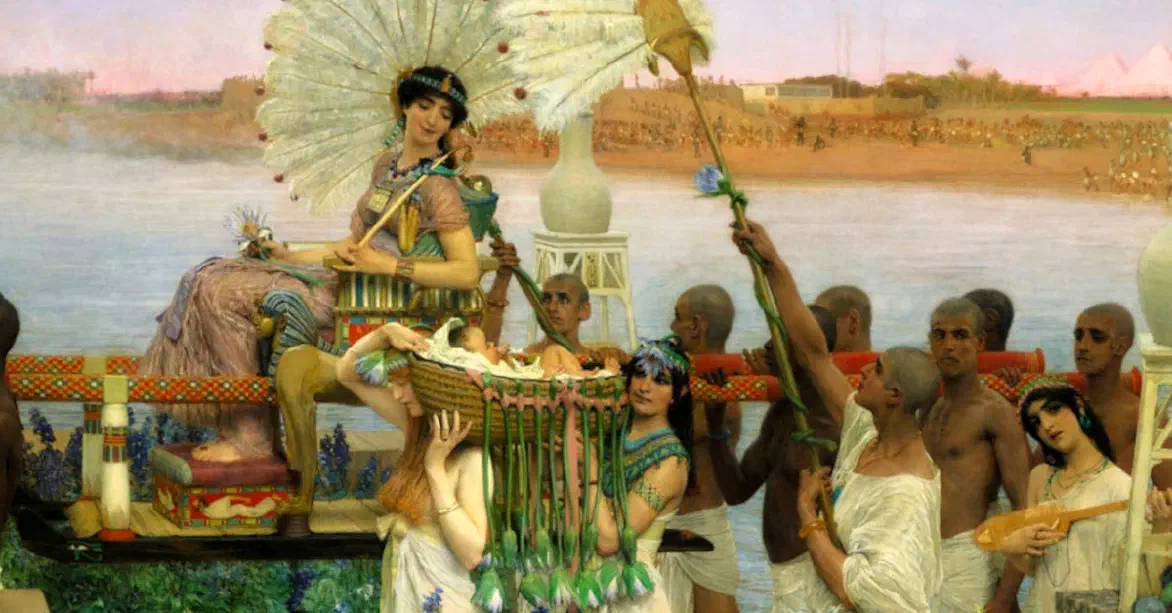
Exodus 2 records one naming, and it belongs to the Egyptian princess, not to the Hebrew mother: “And she called his name Moses: and she said, Because I drew him out of the water” (Exodus 2:10 ). No Hebrew name is recorded for him. In Hebrew the name carries her stated reason, mashah (מָשָׁה , “to draw out”); in the court’s own language it is the 18th dynasty’s name element, mose, “born of,” carried by Ahmose and by Thutmose I, II, and III. The princess’s name for the child is the dynasty’s element with the god dropped: Thutmose without Thut. A name fit for the royal house, attached to no god.
The pharaoh of the Exodus is never named by the text; the name Rameses (Genesis 47:11 ; Exodus 1:11 ; Exodus 12:37 ) is a place name from a later era, written for readers who knew it. The two counterpoints stand unnamed and named: the king on the throne carried the title son of Ra, and the man sent against him carried a royal name with no god in it, made elohim by the God who sent him.
Every god judged in sequence
Each of the ten strokes hit a domain Egypt had assigned to one of its gods, from the Nile to the sun to the throne itself; the full table and the god entries stand in the gods of Egypt. Egypt’s own experts could only imitate, and only downward: they copied the blood and the frogs, adding to both (Exodus 7:22 ; 8:7 ), failed at the lice and told Pharaoh, “This is the finger of God” (Exodus 8:18-19 ), and at the boils could not appear at all, “for the boil was upon the magicians, and upon all the Egyptians” (Exodus 9:11 ).
The narrative states the outcome twice in its own words. In the song after the sea: “Who is like unto thee, O LORD, among the gods?” (Exodus 15:11 ). And from the outside witness, Jethro the priest of Midian: “Now I know that the LORD is greater than all gods: for in the thing wherein they dealt proudly he was above them” (Exodus 18:11 ).
My firstborn for yours
The tenth stroke was announced before the first, and the announcement is the authority claim in one sentence: “Israel is my son, even my firstborn” and “if thou refuse to let him go, behold, I will slay thy son, even thy firstborn” (Exodus 4:22-23 ). At midnight the LORD smote “all the firstborn in the land of Egypt, from the firstborn of Pharaoh that sat on his throne unto the firstborn of the captive that was in the dungeon” (Exodus 12:29 ); “there was not a house where there was not one dead” (Exodus 12:30 ). Against Israel, “shall not a dog move his tongue” (Exodus 11:7 ). The man who had ordered Israel’s sons into the river (Exodus 1:22 ) lost his own son, and then his army in the water.
The purpose was stated in advance: “for this cause have I raised thee up, for to shew in thee my power; and that my name may be declared throughout all the earth” (Exodus 9:16 ; quoted by Paul in Romans 9:17 ). The candidate the Egyptian record offers for this pharaoh, unnamed in the text and matched by profile, stands in who was the pharaoh of the Exodus.
The same authority in the believer’s hand
The New Testament runs on the same structure. “All power is given unto me in heaven and in earth” (Matthew 28:18): the word is exousia (ἐξουσία , “authority, the right to act”), and the next sentence commissions the disciples on the ground of it, “Go ye therefore” (Matthew 28:19 ). The delegation is explicit in Luke: “he called his twelve disciples together, and gave them power and authority over all devils, and to cure diseases” (Luke 9:1), and again to the seventy, “Behold, I give unto you power to tread on serpents and scorpions, and over all the power of the enemy” (Luke 10:19). Two Greek words do the work: exousia, the delegated right, and dynamis (δύναμις , “power, ability”), the enemy’s strength; the verse ranks the believer’s given right over all the enemy’s ability. “In my name shall they cast out devils” (Mark 16:17 ); “ye shall receive power, after that the Holy Ghost is come upon you” (Acts 1:8 ).
The ground of the delegation is the triumph itself: “having spoiled principalities and powers, he made a shew of them openly, triumphing over them in it” (Colossians 2:15 ), and the one raised and seated “far above all principality, and power, and might, and dominion, and every name that is named” is given as “head over all things to the church” (Ephesians 1:20-22 ). What God did through one man made elohim against Egypt’s gods, he now does through the believer against the same class of being.
The boundary at Ephesus
The delegation has a boundary, and Acts 19 marks it. Seven sons of Sceva, a Jewish chief priest, took up the formula without the commission: “We adjure you by Jesus whom Paul preacheth” (Acts 19:13). The evil spirit’s answer sorts name from authority: “Jesus I know, and Paul I know; but who are ye?” (Acts 19:15). The man “leaped on them, and overcame them,” and they fled the house naked and wounded (Acts 19:16).
Egypt’s magicians and Ephesus’s exorcists measure the same thing from two ends: the magicians, backed by real gods, conceded at the third stroke; the exorcists, holding a borrowed name, fell at the first attempt.