

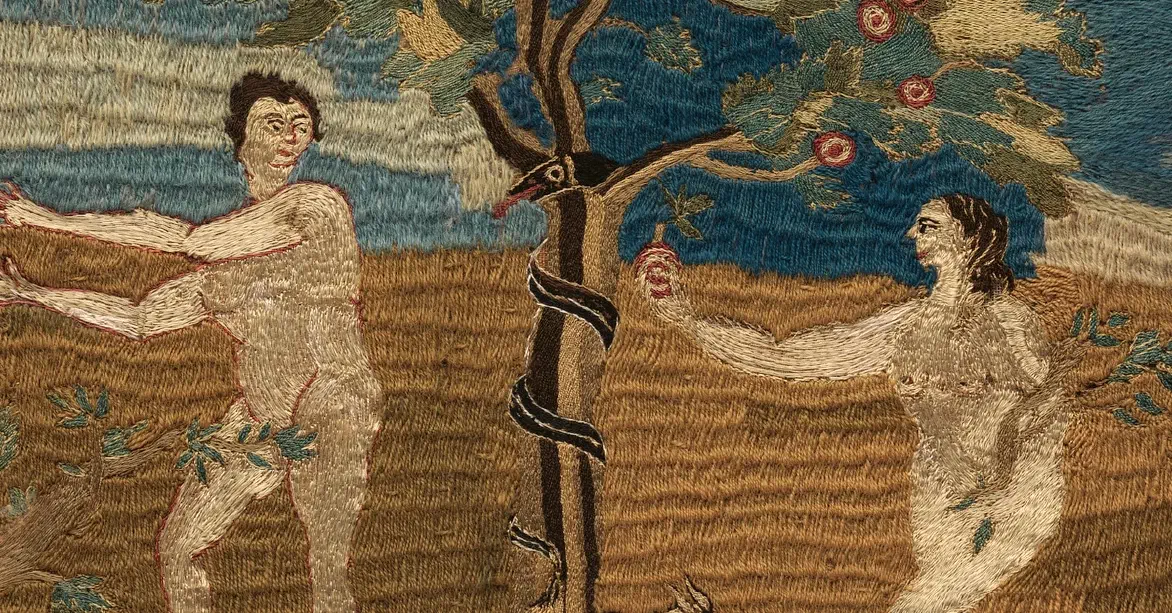
Genesis never names the forbidden fruit but records exactly what it did
The Bible never names the fruit. The apple enters the story through the Latin malum, a word meaning both evil and apple, and through the art and sermons built on that pun. What Genesis 3 records is the effect: the eyes of both were opened, and the first products of the new knowledge were shame (3:7), fear (3:10), and blame (3:12). God himself confirmed the transfer: “the man is become as one of us, to know good and evil” (3:22). The chapter’s only recorded deaths are the animals whose skins covered the guilty pair (3:21), and its closing word toward the serpent is a war declaration between his seed and the woman’s seed (3:15).

The command and Eve’s version of it
God spoke the prohibition to Adam before Eve existed:
And the Lord God commanded the man, saying, Of every tree of the garden thou mayest freely eat: But of the tree of the knowledge of good and evil, thou shalt not eat of it: for in the day that thou eatest thereof thou shalt surely die. Genesis 2:16-17 KJV
Eve is formed six verses later (Genesis 2:22 ). Genesis never records God repeating the command to her, and never records Adam passing it on. When the serpent questions her, she knows a version of it:
And the woman said unto the serpent, We may eat of the fruit of the trees of the garden: But of the fruit of the tree which is in the midst of the garden, God hath said, Ye shall not eat of it, neither shall ye touch it, lest ye die. Genesis 3:2-3 KJV
Her version diverges from the recorded command in three places:
| God’s command (2:16-17) | Eve’s version (3:2-3) |
|---|---|
| Of every tree thou mayest freely eat | We may eat of the fruit of the trees |
| Thou shalt not eat of it | Ye shall not eat of it, neither shall ye touch it |
| Thou shalt surely die | Lest ye die |
The permission shrinks, the prohibition grows a touching ban, and the certain penalty becomes a possibility. Who added the touching ban, the text does not record: the candidates are Adam as transmitter and Eve herself, and the text assigns it to no one.
The nachash
The serpent of Genesis 3:1 is the nachash (נָחָשׁ , “serpent”). The same word runs through the Old Testament’s divination vocabulary. As a verb, nachash means to divine: Joseph says of himself, “wot ye not that such a man as I can certainly divine?” (Genesis 44:15 ), and Israel is forbidden the practice, “neither shall ye use enchantment” (Leviticus 19:26 ). Numbers 23:23 sets both divination words in one verse: “Surely there is no enchantment (nachash) against Jacob, neither is there any divination (qesem, קֶסֶם ) against Israel” (Numbers 23:23 ). The same consonant family also gives nechoshet (נְחֹשֶׁת , “brass”), the shining metal: Moses makes “a serpent of brass,” nechash nechoshet (Numbers 21:9 ).
The antagonist’s name sits inside the vocabulary of forbidden sight. His identity, though, does not rest on word family. The New Testament states it: “the great dragon was cast out, that old serpent, called the Devil, and Satan” (Revelation 12:9 ; also 20:2). Paul writes that “the serpent beguiled Eve through his subtilty” (2 Corinthians 11:3 ), and warns that “Satan himself is transformed into an angel of light” (2 Corinthians 11:14 ).
What happened, in the order the text gives it
The last verse before the serpent reads: “And they were both naked (arummim, עֲרוּמִּים ), the man and his wife, and were not ashamed” (Genesis 2:25 ). The next verse opens: “NOW the serpent was more subtil (arum, עָרוּם ) than any beast of the field” (3:1). Naked and subtil stand one verse apart, on the same root.
The serpent’s three moves follow: a question that misquotes the permission, “Yea, hath God said, Ye shall not eat of every tree of the garden?” (3:1); a flat denial of the penalty, “Ye shall not surely die” (Genesis 3:4 ); and an offer, “your eyes shall be opened, and ye shall be as gods, knowing good and evil” (Genesis 3:5 ).
Eve’s three observations precede the act: she “saw that the tree was good for food, and that it was pleasant to the eyes, and a tree to be desired to make one wise” (Genesis 3:6 ). Then the verse’s beats, in order: she took, she ate, she gave to her husband “with her,” and he ate. Adam is present at the scene.
The result: “And the eyes of them both were opened, and they knew that they were naked; and they sewed fig leaves together, and made themselves aprons” (Genesis 3:7 ).
What the scene does not contain is what the tradition added:
| The tradition | The text |
|---|---|
| The fruit was an apple | The fruit is never named; the apple enters through the Latin malum |
| Adam was absent during the temptation | “gave also unto her husband with her” (3:6) |
| Adam ate out of love, choosing to die with her | No motive is recorded, only “and he did eat” (3:6); the fullest literary form of this reading is Milton’s Paradise Lost, Book 9, where Adam eats knowingly to share Eve’s fate |
The New Testament’s single comment on the difference between the two eaters: “And Adam was not deceived, but the woman being deceived was in the transgression” (1 Timothy 2:14 ).
The promise and the delivery
| The promise (3:5) | The delivery |
|---|---|
| Your eyes shall be opened | “The eyes of them both were opened,” and what they saw was their nakedness (3:7) |
| Ye shall be as gods | Hiding from God’s voice among the trees (3:8 ) |
| Knowing good and evil | Shame (3:7); fear, “I was afraid, because I was naked” (3:10 ); blame, “The woman whom thou gavest to be with me, she gave me of the tree” (3:12 ) |
God himself confirms the knowledge transfer: “Behold, the man is become as one of us, to know good and evil” (Genesis 3:22 ). The promise of knowledge was kept. What came with it was the first shame, the first fear, and the first blame on record.
Two of these three products are named in the New Testament as the devil’s continuing instruments. His standing title is the accuser: “the accuser of our brethren is cast down, which accused them before our God day and night” (Revelation 12:10 ). Fear of death is his bondage instrument: he is “him that had the power of death, that is, the devil,” holding those “who through fear of death were all their lifetime subject to bondage” (Hebrews 2:14-15 ).
The interrogation at the scene questions Adam (“Where art thou?”, 3:9; “Hast thou eaten of the tree?”, 3:11) and questions Eve (“What is this that thou hast done?”, 3:13 ). The serpent is never questioned. He receives no invitation to answer, only the sentence (3:14-15 ).
Rebellion is as the sin of witchcraft
The act’s own classification comes from the prophet Samuel, spoken to king Saul:
For rebellion is as the sin of witchcraft, and stubbornness is as iniquity and idolatry. Because thou hast rejected the word of the Lord, he hath also rejected thee from being king. 1 Samuel 15:23 KJV
The Hebrew sets meri (מֶרִי , “rebellion”) against chatat-qesem (חַטַּאת־קֶסֶם , “sin of divination”), the second of the two divination words from Numbers 23:23. The “idolatry” of the same verse is teraphim (תְּרָפִים ), household gods.
The pitch in Eden was divination-shaped: hidden sight, opened eyes, knowledge reserved to God. The act was rebellion against a spoken command, “Because thou hast hearkened unto the voice of thy wife, and hast eaten of the tree, of which I commanded thee” (Genesis 3:17 ). Samuel’s verse equates the two classes. Reading the fruit’s recorded effect, an altered perception and a new knowing, as the divination class of act is this site’s synthesis; the verse chain above is the text’s own.
The New Testament word rendered “witchcraft” is pharmakeia (φαρμακεία ), built on pharmakon, a drug or potion. The KJV renders it “witchcraft” (Galatians 5:20 ), “sorceries” (Revelation 9:21 ; 18:23, “by thy sorceries were all nations deceived”), and “sorcerers” (Revelation 21:8 ; 22:15). In Revelation’s usage, deception and pharmakeia travel together.
A Second Temple witness runs on the same track. 1 Enoch 7:1 records that the watchers “taught them charms and enchantments, and the cutting of roots, and made them acquainted with plants,” and 8:3 names Semjâzâ as teaching “enchantments, and root-cuttings” (Charles translation). In that witness, forbidden knowledge passed from fallen heavenly beings to humans through plant and root craft. Cited as testimony, not as authority.
The entry accounting stays on the undeceived party: “by one man sin entered into the world, and death by sin” (Romans 5:12 ).
The transferred dominion
The dominion was man’s first: “let them have dominion over the fish of the sea, and over the fowl of the air, and over the cattle, and over all the earth” (Genesis 1:26 ; also 1:28). Psalm 8:6 restates it: “Thou madest him to have dominion over the works of thy hands” (Psalm 8:6 ).
In the wilderness, Satan claims to hold it: “All this power will I give thee, and the glory of them: for that is delivered unto me” (Luke 4:6 ). Jesus does not dispute the claim. He refuses the worship: “Thou shalt worship the Lord thy God, and him only shalt thou serve” (Luke 4:8 ).
The title “prince of this world” appears three times, all in the week of the crucifixion (John 12:31 ; 14:30 ; 16:11 ), and its first occurrence announces the end of the reign: “Now is the judgment of this world: now shall the prince of this world be cast out.” Paul names him “the god of this world” (2 Corinthians 4:4 ).
When the delivery happened, the text does not date. The fall is the only candidate event the text offers; that the dominion changed hands there is inference, marked as such.
Genesis records no motive for the serpent. The envy reading comes from the witnesses: “through envy of the devil came death into the world” (Wisdom of Solomon 2:24, deuterocanonical), and the pseudepigraphal Vita Adae et Evae (chapters 12-16) has Satan refuse to honor the newly created Adam. On the name the tradition later gave him: Lucifer is a Latin word the KJV turned into a name.
The boat humanity now shares with him has a recorded destination: “everlasting fire, prepared for the devil and his angels” (Matthew 25:41 ), a fire prepared for someone else.
The skins
The sentence was “in the day that thou eatest thereof thou shalt surely die” (2:17). They ate, and the interrogation finds them alive. Adam’s physical death waits 930 years (Genesis 5:5 ). The death that came that day is the state the New Testament calls “dead in trespasses and sins” (Ephesians 2:1 ). The physical death is scheduled by removal: “lest he put forth his hand, and take also of the tree of life, and eat, and live for ever: Therefore the Lord God sent him forth from the garden of Eden” (3:22-23).
Then the covering: “Unto Adam also and to his wife did the Lord God make coats of skins (kotnot or, כָּתְנוֹת עוֹר ), and clothed them” (Genesis 3:21 ). Skins presuppose dead animals. The only deaths recorded in the chapter are the animals’, and the covering the pair made for themselves, fig-leaf aprons (3:7), is replaced by a covering God made.
Reading the skins as substitution, the sentence of the day carried by animals, is inference from the sequence, marked as such. The text calls it no sacrifice; the first recorded sacrifice is Abel’s (Genesis 4:4 ). The New Testament states the principle the sequence already shows: “without shedding of blood is no remission” (Hebrews 9:22 ).
The war declaration
And I will put enmity between thee and the woman, and between thy seed and her seed; it shall bruise thy head, and thou shalt bruise his heel. Genesis 3:15 KJV
Everywhere else in Genesis, seed is reckoned through the man. Here the decisive seed is the woman’s. How that seed legally reached David’s throne is traced in the article on the virgin birth.
The war’s outcome is recorded: “the devil that deceived them was cast into the lake of fire and brimstone” (Revelation 20:10 ).
What Genesis 3 closed, Revelation opens
| Genesis | Revelation |
|---|---|
| Tree of life guarded (3:22-24) | “To him that overcometh will I give to eat of the tree of life” (2:7); “right to the tree of life” restored (22:14) |
| Death sentence (2:17) | “Shall not be hurt of the second death” (2:11); “no more death” (21:4) |
| Bread earned in sweat (3:19) | “I will give to eat of the hidden manna” (2:17) |
| Cursed ground, thorns and thistles (3:17-18) | “There shall be no more curse” (22:3) |
| Naked, self-covered (3:7) | “Clothed in white raiment” (3:5) |
| Sent forth, driven out (3:23-24) | “He shall go no more out” (3:12) |
| Dominion given to man (1:26-28), claimed by Satan (Luke 4:6) | “Power over the nations” (2:26); “sit with me in my throne” (3:21) |
The tree that a flaming sword guarded in Genesis bears monthly in the last chapter of the Bible, and its leaves heal nations:
In the midst of the street of it, and on either side of the river, was there the tree of life, which bare twelve manner of fruits, and yielded her fruit every month: and the leaves of the tree were for the healing of the nations. And there shall be no more curse. Revelation 22:2-3 KJV
References
- R.H. Charles (translator), 1 Enoch 7:1 and 8:3: the watchers teach charms, enchantments, and root-cuttings.
- Wisdom of Solomon 2:24 (KJV Apocrypha): envy of the devil as the entrance of death into the world.
- Vita Adae et Evae 12-16: Satan’s refusal to honor the newly created Adam.
- John Milton, Paradise Lost, Book 9: Adam’s knowing choice to share Eve’s fate.