

Hebrew idioms the English Bible carries without translating
Hebrew speaks in pictures: a stingy man has an evil eye, a man relieving himself covers his feet. The KJV translators often kept the picture and left the meaning behind, which preserved the Hebrew for anyone willing to look, and confused everyone else.

Cover his feet
Idiom: לְהָסֵךְ אֶת־רַגְלָיו , “to cover his feet.” Meaning: to relieve oneself, the posture of squatting with the robe draped over the feet.
Judges 3:24 : Eglon’s servants find the doors locked and conclude, “Surely he covereth his feet in his summer chamber.” The king, they assume, is at his toilet, which is why they wait until embarrassment outweighs patience while Ehud escapes.
1 Samuel 24:3 : “Saul went in to cover his feet: and David and his men remained in the sides of the cave.” The comedy of the scene is invisible in a literal reading: Saul chooses, out of every cave in Engedi, the one where David hides, and is caught at his most defenseless.
The apple of the eye
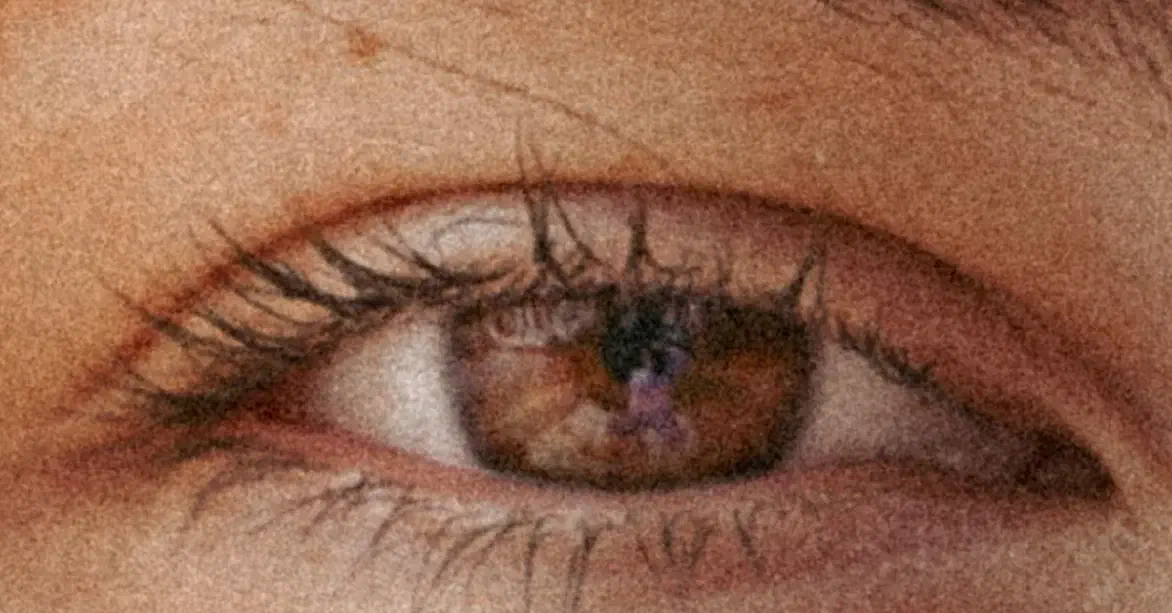
Idiom: אִישׁוֹן עַיִן (ishon ayin), “the little man of the eye.” Meaning: the pupil, named for the tiny reflection of yourself standing in another person’s pupil when you look at them closely.
Deuteronomy 32:10 : God kept Jacob “as the apple of his eye.” Psalm 17:8 : “Keep me as the apple of the eye.” The English “apple” is not in the Hebrew at all; it is the English idiom for the pupil, used by the translators to render the Hebrew one. To be the ishon of God’s eye is to be close enough to him that your image stands in his gaze.
Zechariah 2:8 turns the idiom into a threat assessment: “he that toucheth you toucheth the apple of his eye.” The Hebrew here is babah (בָּבָה , “pupil”), a word that occurs only in this verse; the English apple covers both. The pupil is the one part of the body that cannot be armored and answers to the fastest reflex the body has.
A good eye and an evil eye
Idiom: עַיִן טוֹבָה (ayin tovah, “good eye”) / עַיִן רָעָה (ayin ra’ah, “evil eye”). Meaning: generous / stingy.
The Old Testament sets the usage. Proverbs 22:9 : “He that hath a bountiful eye shall be blessed; for he giveth of his bread to the poor” (the Hebrew reads “good eye”). Proverbs 23:6 : “Eat thou not the bread of him that hath an evil eye”: the grudging host of the following verses, who counts what you eat.
Jesus uses the idiom in Matthew 6:22-23 : “if therefore thine eye be single, thy whole body shall be full of light. But if thine eye be evil, thy whole body shall be full of darkness.” Read as an idiom about generosity, the saying stops floating: it sits between “lay not up for yourselves treasures upon earth” (6:19-21 ) and “ye cannot serve God and mammon” (6:24 ). The entire block is about money. The evil-eyed man, the hoarder, is dark inside; the generous man is full of light. Mishnaic usage confirms the idiom was standard (Avot’s “good eye” as the mark of Abraham’s disciples).
Coals of fire on his head
Idiom: “thou shalt heap coals of fire upon his head” (Proverbs 25:21-22 , quoted by Paul in Romans 12:20 ). Meaning: debated.
The verse commands feeding a hungry enemy. Two readings of the coals: burning shame that leads to repentance (kindness as the hottest rebuke), or an Egyptian repentance rite in which a penitent carried a basin of burning coals on his head as a public sign of contrition, a parallel proposed by Siegfried Morenz from Egyptian texts, which would make the idiom “you will move him to repentance.” Both readings agree on the outcome Paul draws: “Be not overcome of evil, but overcome evil with good” (Romans 12:21 ). Neither reading supports the folk interpretation of secretly hurting your enemy with niceness; the proverb’s next line is “and the LORD shall reward thee.”
Under the fig tree
Idiom: sitting “under the fig tree.” Meaning: in rabbinic usage, the place of undisturbed Torah study and meditation; in the prophets, the picture of covenant peace (“every man under his vine and under his fig tree,” Micah 4:4 , Zechariah 3:10 ).
John 1:48-50 : Jesus tells Nathanael, “Before that Philip called thee, when thou wast under the fig tree, I saw thee”, and Nathanael, on that detail alone, answers: “Rabbi, thou art the Son of God; thou art the King of Israel.” The confession is oversized for a report of where he sat. Rabbinic literature pairs the fig tree with Torah study: Rabbi Hiyya bar Abba and his disciples, in other traditions Rabbi Akiva’s or Rabbi Yehoshua’s, “were accustomed to sit and study beneath a certain fig tree” (Song of Songs Rabbah 6:2). If the fig tree marks private meditation on the scriptures, then Jesus is telling Nathanael I saw what you were meditating on when no one was there, and the confession fits the claim.
Let the dead bury their dead
Idiom: “Let the dead bury their dead” (Matthew 8:21-22 ). Meaning: the disciple’s request “suffer me first to go and bury my father” likely does not mean his father died that morning: a man in fresh bereavement would not be out on the road. In Judean practice burial came in two stages: the body was entombed immediately, and a year later the bones were gathered into an ossuary (secondary burial). “Bury my father” on this reading means “let me finish my family duty, up to a year.” Jesus’ answer, let the (spiritually) dead handle the tombs and “go thou and preach the kingdom of God” (Luke 9:60 ), refuses the delay, not the funeral. The reading is Byron McCane’s documented proposal, not a certainty; on any reading the saying ranks the kingdom’s urgency above the most sacred family duty in Judaism.
Through the eye of a needle
The two popular softenings of this saying both fail.
Mark 10:25 : “It is easier for a camel to go through the eye of a needle, than for a rich man to enter into the kingdom of God.”
The gate story. The claim that Jerusalem had a small night-gate called “the Needle’s Eye” that a camel could squeeze through on its knees has no ancient source. No first-century text, no excavation. It surfaces in medieval commentary, a millennium late.
The rope variant. A few late Greek manuscripts read κάμιλος (kamilos, “rope”) for κάμηλος (kamelos, “camel”), an itacism (the two words sounded identical) that also happens to soften the saying. The early manuscripts read camel.
The rabbis used the identical figure for impossibility, “an elephant through the eye of a needle” (Babylonian Talmud, Berakhot 55b), with the largest local animal in each case: elephant in Babylon, camel in Judea. The hyperbole is the point. The disciples heard it at full strength: “Who then can be saved?” (Mark 10:26 ). The answer offers no gate: “With men it is impossible, but not with God” (10:27 ).
Bowels of mercies
Idiom: רַחֲמִים (rachamim, “compassions”), from rechem (רֶחֶם , “womb”); Greek σπλάγχνα (splanchna, “inward parts”). Meaning: compassion located where the body feels it: the gut, and in the Hebrew root the womb, mother-love as the anatomy of mercy.
The KJV renders it literally: “bowels of mercies” (Colossians 3:12 ), “the bowels of Jesus Christ” (Philippians 1:8 ). The gospel verb splanchnizomai (σπλαγχνίζομαι , “moved with compassion”, Matthew 9:36 , Mark 1:41 ) is this idiom in action: compassion as a physical event. When Isaiah asks “Can a woman forget her sucking child, that she should not have compassion (racham) on the son of her womb?” (Isaiah 49:15 ), the mercy verb carries the womb in its root.
References
- Babylonian Talmud, Berakhot 55b: an elephant through the eye of a needle as a figure of impossibility.
- Mishnah, Avot 2:9 and 5:19: the good eye as generosity of spirit.
- Byron R. McCane, “Let the Dead Bury Their Own Dead: Secondary Burial and Matt 8:21-22,” Harvard Theological Review 83 (1990): the ossilegium reading.
- Siegfried Morenz, “Feurige Kohlen auf dem Haupt,” Theologische Literaturzeitung 78 (1953): the Egyptian coal-basin repentance parallel to Proverbs 25:22.
- Song of Songs Rabbah 6:2: the sages accustomed to sit and study beneath a fig tree.
- Babylonian Talmud, Eruvin 54a: matters of Torah compared to a fig tree.
- Babylonian Talmud, Berakhot 57a: a fig tree in a dream as a sign of Torah preserved within.