

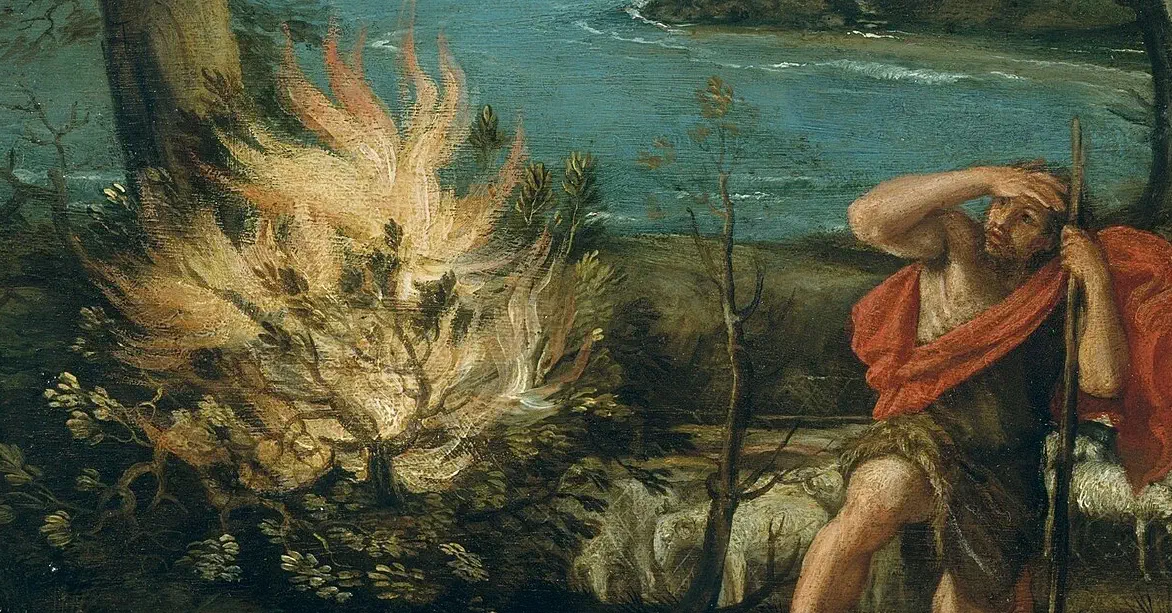
Who Jesus is and why he says I am 37 times in the New Testament
The Hebrew name God gives Moses in Exodus 3:14 is ehyeh (אֶהְיֶה , “I will be”). It appears 37 times in the Old Testament. The Greek construction Jesus uses in the New Testament, ego eimi (ἐγώ εἰμι , “I am”), appears exactly 37 times as well. The number 37 is the prime factor of 2701, the gematria value of Genesis 1:1 . The author of creation identified himself to Moses with a name that appears 37 times. The one who claims that name in the New Testament uses the same construction exactly 37 times.

The name God gave Moses
Ehyeh (אֶהְיֶה , “I will be”) is first-person imperfect of the verb hayah (הָיָה , “to be”). The imperfect aspect in Hebrew expresses ongoing, incomplete action, a continuous becoming. The standard English rendering “I AM” flattens this. A more precise rendering is “I will be” or “I am being.”
Exodus 3:14 contains the word three times in three words: Ehyeh Asher Ehyeh.
| Word | Hebrew | Value |
|---|---|---|
| Ehyeh | אֶהְיֶה | 1 + 5 + 10 + 5 = 21 |
| Asher | אֲשֶׁר | 1 + 300 + 200 = 501 |
| Ehyeh | אֶהְיֶה | 1 + 5 + 10 + 5 = 21 |
21 + 501 + 21 = 543
501 = 3 x 167. 167 is the 39th prime. 21 = 3 x 7. The phrase total: 543. Digit sum: 5 + 4 + 3 = 12.
Rabbi Yoseph Bechor Shor on Exodus 3:14 identifies the three tenses embedded in the name: Yihyeh (יִהְיֶה , He Will Be), Hoveh (הוֹוֶה , He Is), Hayah (הָיָה , He Was). Revelation 11:17 renders the same threefold identification in Greek: “which art, and wast, and art to come.”
Ehyeh appears 37 times in the Old Testament
The word אֶהְיֶה occurs exactly 37 times across the Old Testament. Gematria of Ehyeh: 21. Total value across all 37 occurrences: 21 x 37 = 777.
The three occurrences in Exodus 3:14 alone: 21 x 3 = 63 (3 x 3 x 7).
Two occurrences carry structural markers in the chapter and verse numbering of the canon.
First occurrence: Genesis 26:3 . Chapter verse number: 26. The gematria of YHWH (יְהוָה ): 10 + 5 + 6 + 5 = 26.
26th occurrence: Jeremiah 32:38 . Jeremiah 32 is the 777th chapter of the Bible. 777 = 37 x 7 x 3.
37th occurrence: Zechariah 8:8 . Zechariah 8 is the 919th chapter of the Bible. 919 is the 157th prime. 157 is the 37th prime. Zechariah 8:8 is the 22,984th verse in the Bible. 22,984 = 2 cubed x 13 squared x 17 = 26 x 26 x 2 x 17.
Full list of occurrences:
Genesis 26:3, Genesis 31:3 , Exodus 3:12 , Exodus 3:14 (x3), Exodus 4:12 , Exodus 4:15 , Deuteronomy 31:23 , Joshua 1:5 , Joshua 3:7 , Judges 6:16 , 2 Samuel 7:6 , 2 Samuel 7:9 , 2 Samuel 7:14 , 1 Chronicles 17:5 , 1 Chronicles 17:8 , 1 Chronicles 17:13 , 1 Chronicles 28:6 , Psalms 50:21 , Isaiah 3:7 , Jeremiah 11:4 , Jeremiah 24:7 , Jeremiah 30:22 , Jeremiah 31:1 , Jeremiah 32:38, Ezekiel 11:20 , Ezekiel 14:11 , Ezekiel 34:24 , Ezekiel 36:28 , Ezekiel 37:23 , Hosea 1:9 , Hosea 11:4 , Hosea 14:5 , Zechariah 2:5 (x2), Zechariah 8:8
Ego eimi appears 37 times in the New Testament
Ego eimi (ἐγώ εἰμι , “I am”) is the construction the Septuagint uses to render Ehyeh in Exodus 3:14. When Jesus uses it in the New Testament, the claim is identificatory.
Isopsephy of ego eimi:
| Letter | Greek | Value |
|---|---|---|
| ε | epsilon | 5 |
| γ | gamma | 3 |
| ω | omega | 800 |
| ε | epsilon | 5 |
| ι | iota | 10 |
| μ | mu | 40 |
| ι | iota | 10 |
5 + 3 + 800 + 5 + 10 + 40 + 10 = 873
873 = 3 x 3 x 97. 97 is the 25th prime.
Total value across all 37 occurrences: 873 x 37 = 32,301.
Full list of occurrences:
Matthew 14:27 , Matthew 22:32 , Mark 6:50 , Mark 14:62 , Luke 22:70 , Luke 24:39 , John 4:26 , John 6:20 , John 6:35 , John 6:41 , John 6:48 , John 6:51 , John 8:12 , John 8:18 , John 8:24 , John 8:28 , John 8:58 , John 10:7 , John 10:9 , John 10:11 , John 10:14 , John 11:25 , John 13:19 , John 14:6 , John 15:1 , John 15:5 , John 18:5 , John 18:6 , John 18:8 , Acts 9:5 , Acts 18:10 , Acts 22:8 , Acts 26:15 , Revelation 1:8 , Revelation 1:17 , Revelation 2:23 , Revelation 22:16
37 and Genesis 1:1
The number 37 is structural to Scripture. Genesis 1:1 in Hebrew has a gematria value of 2701. 2701 = 37 x 73. These two factors are mirror images of each other. 37 is the 12th prime. 73 is the 21st prime, and 21 is the gematria value of Ehyeh.
The opening verse of the Bible encodes the same number that structures the name God gives to Moses and the number of times Jesus uses that name’s Greek equivalent in the New Testament. The author signed the first verse with the arithmetic of his own self-identification.
References
- Rabbi Yoseph Bechor Shor, Commentary on the Torah, on Exodus 3:14: three tenses (past, present, future) embedded in the divine name ehyeh asher ehyeh.