

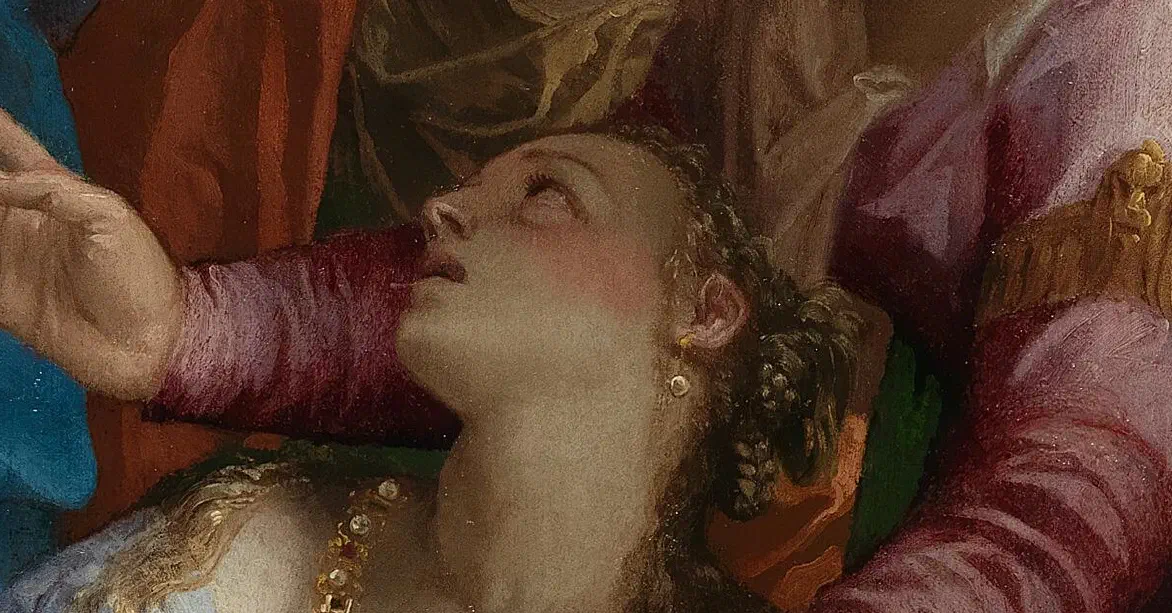
No verse calls Mary Magdalene a prostitute
The New Testament says three things about Mary Magdalene: seven devils went out of her, she funded the ministry from her own substance, and she was the first human being to see the risen Christ. It never calls her a prostitute. That identification has a birthday and an author: 591 AD, Gregory the Great, Homily 33. The Greek East never accepted it, and Rome itself walked it back fourteen centuries later.

What the text says
And certain women, which had been healed of evil spirits and infirmities, Mary called Magdalene, out of whom went seven devils, And Joanna the wife of Chuza Herod’s steward, and Susanna, and many others, which ministered unto him of their substance. Luke 8:2-3 KJV
Magdalene (Μαγδαληνή ) means “of Magdala,” a fishing town on the western shore of Galilee; the name derives from migdal (מִגְדָּל , “tower”). She is identified by her town rather than by a husband or son, the way the text handles a woman with independent standing. She appears in the support list next to the wife of Herod’s steward, “ministering of their substance”: these are patrons.
Her record after Luke 8: present at the crucifixion in all four gospels (Matthew 27:56 , Mark 15:40 , Luke 23:49 with “the women that followed him from Galilee,” John 19:25 ); watching the burial (Matthew 27:61 ); first at the tomb while it was yet dark (John 20:1 ); first to see the risen Lord and first commissioned to announce it (John 20:14-18 , Mark 16:9 ).
The gospels never treat demonization as a moral verdict: the afflicted boy of Mark 9 and the man of the tombs in Mark 5 receive deliverance, not censure. Luke reports her deliverance in the same breath as “healed of evil spirits and infirmities.”
The three women Gregory merged
The New Testament contains three separate figures:
| Woman | Text | What is said |
|---|---|---|
| The sinful woman | Luke 7:36-50 | Unnamed; anoints Jesus’ feet in Simon the Pharisee’s house; “a sinner” (ἁμαρτωλός , hamartolos, unspecified) |
| Mary Magdalene | Luke 8:2 | Introduced after the Luke 7 scene, as if new to the reader; seven devils, patron |
| Mary of Bethany | John 11:1-2 , 12:3 | Sister of Martha and Lazarus; anoints Jesus before the passion |
Luke introduces Magdalene in 8:2 with a full identification (town, deliverance, role) immediately after the sinful-woman episode. An author does not formally introduce a character the reader just met. The two anointings are separate events in separate towns (Galilee vs Bethany) with separate hosts (Simon the Pharisee vs the house of Lazarus; the Simon of Bethany in Matthew 26:6 is “the leper,” a different Simon).
591 AD: the sermon
Gregory the Great, Homily 33 (591 AD), declared the three to be one: the woman Luke calls a sinner and John calls Mary of Bethany, Gregory identifies as the Mary from whom seven devils were cast out, and he reads the seven devils as “all the vices.” The unspecified “sinner” hardened into “prostitute,” the ointment became the perfume of her former trade, and the composite penitent entered Western art and liturgy. The English word “maudlin,” from Magdalene, preserves the weeping image the merger created.
It was a sermon by a pope, not a council ruling on a text, but Gregory’s authority made it the Western default for fourteen centuries.
The Greek East never merged the three. The Orthodox calendar keeps Mary Magdalene, Mary of Bethany, and the anonymous penitent as distinct commemorations, and its title for Magdalene is isapostolos (ἰσαπόστολος , “equal to the apostles”).
Rome walks it back
The 1969 reform of the Roman calendar quietly separated the three women again; the readings for Mary Magdalene’s day no longer include Luke 7. In 2016, the Congregation for Divine Worship raised her memorial to the rank of a feast, and the accompanying decree titled her apostolorum apostola (“apostle of the apostles”), a title used for her in medieval commentary (Thomas Aquinas among others) because she was sent by the risen Christ to announce the resurrection to the twelve (John 20:17-18 ).
The witness the story buried
All four evangelists make women the first witnesses of the empty tomb, and John makes Magdalene the first witness of the risen Christ, in a culture where a woman’s testimony carried no legal weight (Josephus states the rule outright). No first-century author inventing a resurrection account would choose, as its foundation witness, a woman formerly possessed by seven devils.
There is possibly one more echo. The Talmud’s garbled Yeshua traditions call his mother “Miriam the women’s hairdresser”: megaddela neshaya, a name that looks like a confused memory of Magdalene attached to the wrong Mary (the ben Pandera tradition).
References
- Gregory the Great, Homily 33 (591 AD): the identification of Mary Magdalene with the sinful woman of Luke 7 and Mary of Bethany, and the seven devils as the seven vices.
- Congregation for Divine Worship, decree of 3 June 2016 (Apostolorum apostola): elevation of the memorial to a feast.
- Josephus, Antiquities 4.219: women’s testimony not admitted.
- Babylonian Talmud, Sanhedrin 67a (uncensored manuscripts; parallel Shabbat 104b): Miriam megaddela neshaya in the ben Pandera tradition.