

Qumran expected Melchizedek to proclaim the Jubilee and judge the gods
Melchizedek appears in Genesis for three verses, in the Psalms for one, and then the Hebrew Bible is silent. The Dead Sea Scroll 11Q13, copied in the first century BC, breaks the silence: it casts Melchizedek as an elohim, the divine figure of Psalm 82 who stands up in the council, proclaims the Jubilee release of Isaiah 61, atones for the sons of light, and executes judgment on Belial. A century later, Jesus stood up in the synagogue at Nazareth, read Isaiah 61, and said: this day is this scripture fulfilled.

Three verses in Genesis
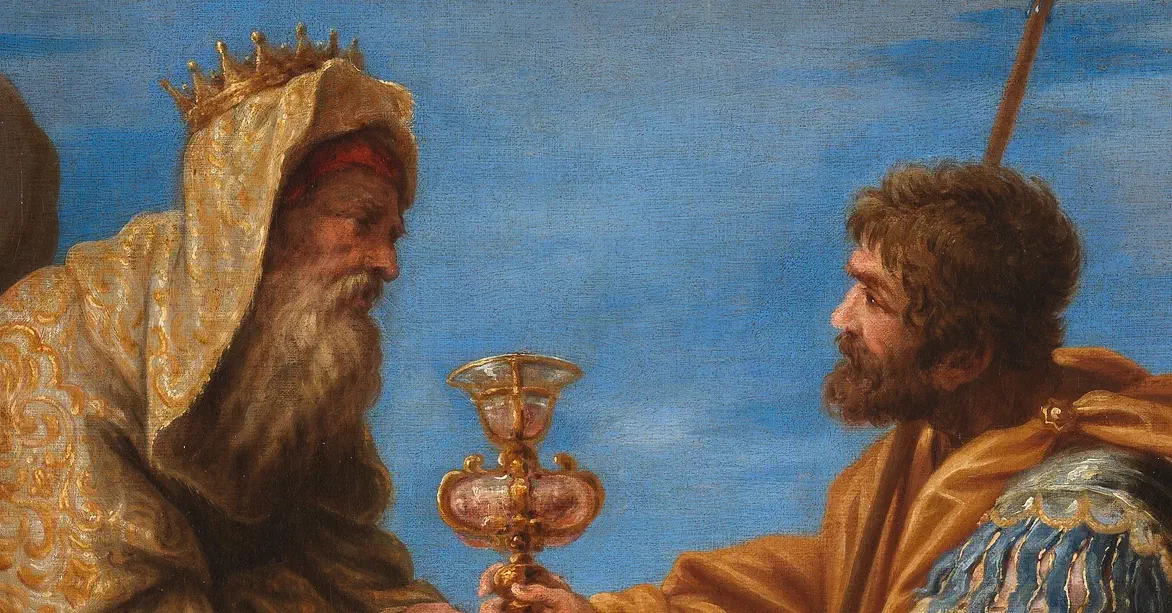
And Melchizedek king of Salem brought forth bread and wine: and he was the priest of the most high God. And he blessed him, and said, Blessed be Abram of the most high God, possessor of heaven and earth: And blessed be the most high God, which hath delivered thine enemies into thy hand. And he gave him tithes of all. Genesis 14:18-20 KJV
Malki-Tzedek (מַלְכִּי־צֶדֶק ) combines melekh (מֶלֶךְ , “king”) and tzedek (צֶדֶק , “righteousness”): king of righteousness. He rules Salem (שָׁלֵם ), the same root as shalom: king of peace. Psalm 76:2 places Salem in Jerusalem (“In Salem also is his tabernacle, and his dwelling place in Zion”). Hebrews 7:2 reads both titles as the point of the name.
He is priest of El Elyon (אֵל עֶלְיוֹן , “God most high”), the title of the Most High in the Deuteronomy 32 allotment and the first of the four names stacked at the opening of Psalm 91. A priesthood of the Most High exists in Canaan, in Jerusalem, four centuries before Sinai and Aaron.
He brings bread and wine. He blesses Abram. Abram gives him a tenth, the first mention of tithing in Scripture, before the Law prescribes it.
One verse in the Psalms
The LORD hath sworn, and will not repent, Thou art a priest for ever after the order of Melchizedek. Psalm 110:4 KJV
Psalm 110 is the psalm Jesus used to silence the temple challenges, “The LORD said unto my Lord” (Matthew 22:41-46 ), immediately after the tribute question. Verse 4 of the same psalm gives David’s Lord a priesthood after the order of Melchizedek, older than Aaron’s and sworn with an oath.
Under the Law, king and priest were separated offices; king Uzziah was struck with leprosy for attempting to burn incense (2 Chronicles 26:16-21 ). The order of Melchizedek is the standing exception: one figure, both offices, established before the Law and outliving it.
What 11Q13 does with him
11Q13 (11QMelchizedek) survives in fragments of a Second Temple commentary that reads three texts as one event:
- Leviticus 25:13 and Deuteronomy 15:2 : the Jubilee release of debts and slaves.
- Isaiah 61:1 : “to proclaim liberty to the captives.”
- Psalm 82:1 : “God standeth in the congregation of the mighty; he judgeth among the gods.”
The scroll’s scenario, in its own sequence: history runs in ten Jubilee cycles. The Law itself joins the Jubilee to the Day of Atonement: the trumpet that proclaims liberty sounds on the tenth day of the seventh month, the annual Day of Atonement (Leviticus 25:9-10 ). The scroll extends that link to the end of history: at the end of the tenth Jubilee comes the final Day of Atonement, when the liberty proclaimed is not from debt but from iniquity. The one who proclaims and executes it is Melchizedek (English quotations follow Vermes and García Martínez):
- He “will return them there and will proclaim to them liberty, forgiving them the wrong-doings of all their iniquities.”
- The scroll quotes Psalm 82:1, where elohim (אֱלֹהִים ) stands in the assembly of El, and identifies the standing elohim as Melchizedek.
- “Melchizedek will avenge the vengeance of the judgments of God” and rescue the sons of light “from the hand of Belial and from the hand of all the spirits of his lot.”
- Quoting Isaiah 52:7 , “that saith unto Zion, Thy God reigneth”, the scroll comments: “your Elohim” is Melchizedek.
In divine council language this is precise: elohim is the class word for beings of the spiritual realm. The scroll keeps Melchizedek distinct from the Most High and makes him the Most High’s executor, the figure who stands up in Psalm 82’s courtroom and carries out the sentence on the corrupt gods of the nations.
This is a Jewish text, written a century or more before the New Testament: the expectation was already on the shelf at Qumran.
Nazareth reads the same scroll
Luke 4:16-21 . Jesus stands up in the synagogue and is handed Isaiah:
The Spirit of the Lord is upon me, because he hath anointed me to preach the gospel to the poor; he hath sent me to heal the brokenhearted, to preach deliverance to the captives, and recovering of sight to the blind, to set at liberty them that are bruised, to preach the acceptable year of the Lord. Luke 4:18-19 KJV
This is Isaiah 61:1-2, the exact text 11Q13 puts in the tenth Jubilee. The “acceptable year” is the Jubilee year (the one-year ministry). He closes the scroll and sits down to teach, the eyes of all in the synagogue fastened on him, and says: “This day is this scripture fulfilled in your ears” (Luke 4:21 ).
To hearers who knew the Melchizedek expectation, the claim had a shape. The one reading is the anointed proclaimer of the Jubilee release, the figure Qumran had already identified with the elohim of Psalm 82. Jesus quotes Psalm 82 of himself in John 10:34 in the same breath as “I and my Father are one.”
Hebrews closes the argument
Hebrews 7 builds the case from the Genesis silence and the Psalm 110 oath:
Without father, without mother, without descent, having neither beginning of days, nor end of life; but made like unto the Son of God; abideth a priest continually. Hebrews 7:3 KJV
Genesis records genealogies obsessively; for Melchizedek it records none. Hebrews treats the omission as design: a priesthood with no line and no end, the pattern for a priest “after the power of an endless life” (Hebrews 7:16 ).
The rank argument: Levi, “yet in the loins of his father” Abraham, paid tithes to Melchizedek (Hebrews 7:9-10 ). The lesser is blessed of the better (7:7 ). The entire Levitical system, before it existed, acknowledged a higher priesthood. Psalm 110:4 then attaches that priesthood to the Messiah with an oath: “The LORD hath sworn, and will not repent.”
The priest-king of Salem meets Abram with bread and wine and a blessing (Genesis 14:18). The priest-king of Psalm 110 takes bread and wine on the night he cuts the new covenant (the Last Supper) and gives them as the signs of his own sacrifice.
References
- 11Q13 (11QMelchizedek), Dead Sea Scrolls, Cave 11 (copy, first century BC): Melchizedek as elohim of Psalm 82:1 and Isaiah 52:7, proclaiming the Jubilee of Leviticus 25/Isaiah 61 and executing judgment on Belial at the end of the tenth Jubilee.
- Geza Vermes, The Complete Dead Sea Scrolls in English; Florentino García Martínez, The Dead Sea Scrolls Translated: text and translation of 11Q13.