

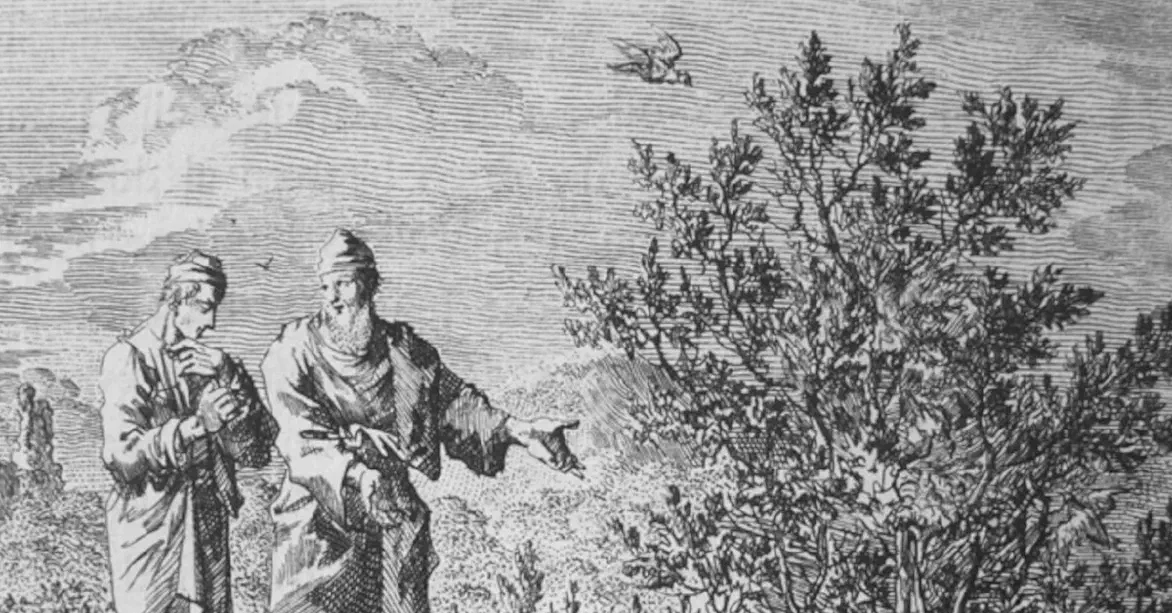
The mustard seed is a weed that becomes a government tree
The mustard seed parable decodes on fixed symbols, and Scripture supplies every one of them. Mustard is an invasive plant: sown once, it self-seeds, spreads through the bed, and resists removal, which is why the kingdom pictured by it enters small and ends up the only thing growing. The tree the plant becomes is the Bible’s standing image of a government, and the birds of every wing that lodge in its branches are the nations coming under that government’s shade. The leaven parable paired with the mustard seed runs the same mechanics in the opposite direction: a hidden agent works until the whole lump is transformed, and leaven carries corruption in every passage that interprets it.

The texts
Another parable put he forth unto them, saying, The kingdom of heaven is like to a grain of mustard seed, which a man took, and sowed in his field: Which indeed is the least of all seeds: but when it is grown, it is the greatest among herbs, and becometh a tree, so that the birds of the air come and lodge in the branches thereof. Matthew 13:31-32 KJV
And he said, Whereunto shall we liken the kingdom of God? or with what comparison shall we compare it? It is like a grain of mustard seed, which, when it is sown in the earth, is less than all the seeds that be in the earth: But when it is sown, it groweth up, and becometh greater than all herbs, and shooteth out great branches; so that the fowls of the air may lodge under the shadow of it. Mark 4:30-32 KJV
Then said he, Unto what is the kingdom of God like? and whereunto shall I resemble it? It is like a grain of mustard seed, which a man took, and cast into his garden; and it grew, and waxed a great tree; and the fowls of the air lodged in the branches of it. Luke 13:18-19 KJV
Matthew and Mark record one occasion: the seaside parable discourse, delivered on the same day as the parable of the sower (Matthew 13:1-2 ). Luke records a later repetition: a synagogue on the Sabbath (Luke 13:10 ), on the journey toward Jerusalem (Luke 13:22 ). The two settings produce different details, and both sets carry meaning.
| Element | Matthew 13 | Mark 4 | Luke 13 |
|---|---|---|---|
| Kingdom of | the heavens | God | God |
| Sown in | his field (ἀγρῷ , agro) | the earth | his garden (κῆπον , kēpon) |
| Grown to | greatest among herbs, becomes a tree | greater than all herbs, great branches | a great tree |
| The birds | lodge in the branches | lodge under the shadow | lodged in the branches |
Matthew’s agros (ἀγρός , “field, open land”) is defined inside the same chapter: “The field is the world” (Matthew 13:38 ). Luke’s kēpos (κῆπος , “garden, enclosed plot”) is the cultivated bed behind a house, the setting his synagogue audience tended. Luke’s “great tree” reads δένδρον μέγα in the Textus Receptus; the modern critical text omits μέγα .
The plant
The phrase kokkos sinapeōs (κόκκῳ σινάπεως , “a grain of mustard”) names the smallest seed a first-century Judean handled, and Jesus uses it elsewhere as the measure of barely visible faith (Matthew 17:20 ). The grown plant outranks its own class: it becomes the greatest of the lachana (λάχανα , “garden herbs, vegetables”) and then “becomes a tree” (γίνεται δένδρον ), an herb finishing in the tree class.
Jewish sowing law kept mustard out of the garden bed. The Mishnah classifies chardal (חַרְדָּל , “mustard”) among the zera’im (זְרָעִים , “seed crops”), the class excluded from the arugah (עֲרוּגָה , “garden bed”):
They may not sow different species of seeds in one bed, but they may sow different species of vegetables in one bed. Mustard and small polished peas are a species of seed. Mishnah Kilayim 3:2
Luke’s man throws the grain into his kēpos anyway. Roman agriculture records what happens next:
This last, though it will grow without cultivation, is considerably improved by being transplanted; though, on the other hand, it is extremely difficult to rid the soil of it when once sown there, the seed when it falls germinating immediately. Pliny, Natural History 19.54 (trans. Bostock and Riley)
Mustard self-seeds the moment the seed touches soil, and a bed that received it once keeps it. The kingdom’s growth shares the property: planted small, self-propagating beyond removal, until the garden holds one plant. Faith works the same way in the simile of Matthew 17:20: belief is meant to overgrow everything else in the bed.
The tree is a government
Scripture reads trees as rulers and their rule. Daniel sees the image in a dream:
The tree grew, and was strong, and the height thereof reached unto heaven, and the sight thereof to the end of all the earth: The leaves thereof were fair, and the fruit thereof much, and in it was meat for all: the beasts of the field had shadow under it, and the fowls of the heaven dwelt in the boughs thereof, and all flesh was fed of it. Daniel 4:11-12 KJV
The chapter interprets its own symbol: “It is thou, O king, that art grown and become strong: for thy greatness is grown, and reacheth unto heaven, and thy dominion to the end of the earth” (Daniel 4:22 ). The Aramaic word is ilana (אִילָנָא , “the tree”), and the tree is the king and his dominion.
Ezekiel 31 pictures Assyria as the cedar of Lebanon, “of an high stature; and his top was among the thick boughs” (Ezekiel 31:3 ). Judges 9 runs on the same idiom: the trees go out to anoint a king over them, and the bramble offers his shadow as the place of trust (Judges 9:8-15 ).
Ezekiel 17 states the whole template in advance, in God’s own planting:
Thus saith the Lord GOD; I will also take of the highest branch of the high cedar, and will set it; I will crop off from the top of his young twigs a tender one, and will plant it upon an high mountain and eminent: In the mountain of the height of Israel will I plant it: and it shall bring forth boughs, and bear fruit, and be a goodly cedar: and under it shall dwell all fowl of every wing; in the shadow of the branches thereof shall they dwell. And all the trees of the field shall know that I the LORD have brought down the high tree, have exalted the low tree, have dried up the green tree, and have made the dry tree to flourish: I the LORD have spoken and have done it. Ezekiel 17:22-24 KJV
Verse 24 names the referent class: the trees of the field are the onlookers, the governments of the earth, watching which tree gets felled and which gets raised. God plants a tender twig (רַךְ , rakh) on the high mountain of Israel, and it becomes the cedar that shelters. The mustard parable is the seed-form of this planting: the smallest thing in the garden becomes the tree the nations live under.
The Septuagint of Ezekiel 17:23 reads καὶ πᾶν πετεινὸν ὑπὸ τὴν σκιὰν αὐτοῦ ἀναπαύσεται (“and every bird shall rest under its shadow”). Mark 4:32 carries the identical phrase ὑπὸ τὴν σκιὰν αὐτοῦ : the Greek parable speaks with the Septuagint’s own words.
The birds are the nations
Ezekiel 17:23 promises shelter to kol tsippor kol-khanaf (כָּל־צִפּוֹר כָּל־כָּנָף , “every bird of every wing”): every kind, the full inventory of wings. Ezekiel’s other cedar passage draws the equation in parallel lines:
All the fowls of heaven made their nests in his boughs, and under his branches did all the beasts of the field bring forth their young, and under his shadow dwelt all great nations. Ezekiel 31:6 KJV
The first line gives the birds nesting (קִנְנוּ , qinnen); the closing line gives the great nations dwelling (יֵשְׁבוּ , yeshevu) in the same shadow. Hebrew parallelism states the second line as the first line’s meaning: the birds in the branches are the nations in the shade.
“Lodge” renders kataskēnoō (κατασκηνόω , “to pitch a tent, to take up dwelling”), built on skēnē (σκηνή , “tent, tabernacle”). The word family carries covenant-dwelling weight through the New Testament:
| Reference | Greek form | KJV rendering |
|---|---|---|
| Matthew 13:32 | κατασκηνοῦν | lodge |
| Mark 4:32 | κατασκηνοῦν | lodge |
| Luke 13:19 | κατεσκήνωσεν | lodged |
| John 1:14 | ἐσκήνωσεν | dwelt |
| Revelation 7:15 | σκηνώσει | shall dwell |
| Revelation 21:3 | σκηνή, σκηνώσει | tabernacle, dwell |
The Word tabernacled among men, and the same verb family places the birds in the branches. The Greek assigns the nations a dwelling in the tree, a sojourning inside the covenant shelter.
One objection stands inside the same chapter. The birds of Matthew 13:4 devour the wayside seed, and Matthew 13:19 identifies them there as the wicked one. The two images assign birds different actions: snatching exposed seed in the sower, nesting in the finished tree here. The Old Testament template fixes the role for the tree image, and the parable follows Ezekiel and Daniel, where the birds receive shelter. The consistency method behind this reading is laid out in The law of first mention.
The leaven twin
Another parable spake he unto them; The kingdom of heaven is like unto leaven, which a woman took, and hid in three measures of meal, till the whole was leavened. Matthew 13:33 KJV
Luke 13:21 repeats it in the same words. Zymē (ζύμη , “leaven”) is hidden (ἐνέκρυψεν , enekrypsen) in the meal and works “till the whole was leavened” (ἕως οὗ ἐζυμώθη ὅλον ). Every passage that interprets leaven assigns it the same register:
| Reference | What leaven is or does |
|---|---|
| Exodus 12:15, 19 | purged from the houses for seven days; the eater is cut off from Israel |
| Leviticus 2:11 | excluded from every offering made by fire |
| Leviticus 23:17 | the single commanded exception: the two firstfruits wave loaves, baked with leaven |
| Matthew 16:6, 11-12 | the doctrine of the Pharisees and Sadducees |
| Mark 8:15 | the leaven of Herod |
| Luke 12:1 | hypocrisy |
| 1 Corinthians 5:6-8 | malice and wickedness, purged for the feast |
| Galatians 5:9 | the agent that leavens the whole lump |
The three measures carry their own reference. Sata tria (σάτα τρία , “three measures”) is the Hebrew shalosh se’im (שְׁלֹשׁ סְאִים ), the se’ah carried into Greek letters. The same three se’ahs of fine meal (קֶמַח סֹלֶת , kemach solet) appear once elsewhere: Sarah kneads them for the LORD and the two angels at Mamre (Genesis 18:6 ). The woman hides the leaven in the measure of the fellowship meal set before God.
The two parables share one grammar: something small enters a mass and works hidden until the whole is transformed. The mustard works from the garden, and the outcome is a tree with the nations in it. The leaven works inside the meal, and the outcome is a leavened whole. Growth to totality runs in both directions.
The grafting parallel
Paul draws the same outcome with a different tree:
And if some of the branches be broken off, and thou, being a wild olive tree, wert graffed in among them, and with them partakest of the root and fatness of the olive tree; Romans 11:17 KJV
The wild olive (ἀγριέλαιος , agrielaios) is grafted (ἐνεκεντρίσθης , enekentristhēs) into the cultivated tree and shares the root. The mechanics differ from the parable: the birds arrive from outside and take their place in the branches, while Paul’s wild branches are cut out and inserted into the trunk. The outcome matches: the nations take their place inside Israel’s covenant tree. Paul closes the argument with the return of the natural branches: “how much more shall these, which be the natural branches, be graffed into their own olive tree?” (Romans 11:24 ).
References
- Pliny the Elder, Natural History 19.54 (trans. Bostock and Riley): mustard grows uncultivated, improves under transplanting, and once sown can hardly be removed from the soil, the fallen seed germinating immediately.
- Mishnah Kilayim 3:2: mustard (chardal) classed among the seed crops that may not be sown in a garden bed.