

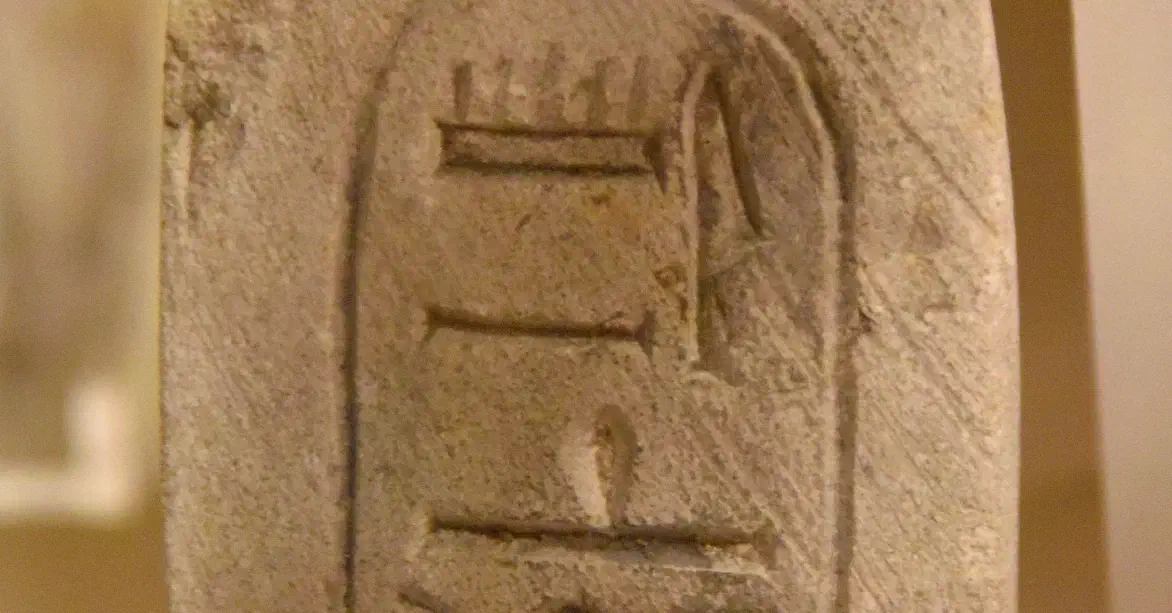
The pharaoh of the Exodus remains unnamed, but the profile matches Amenhotep II
The Bible never names the pharaoh of the Exodus, and the popular answer rests on a place name: Rameses is a toponym from a later era, and the Ramses identification falls with it. What the text gives instead is a profile: a firstborn son who dies before him, a predecessor whose long reign covers the forty years of the Midian exile, and a pharaoh who is never said to drown. One reign in the Egyptian record answers that profile point for point: Amenhotep II of the 18th dynasty, whose tomb KV35 carries the mummies and inscriptions the profile calls for. The identification is held here as a candidate: the strongest match the record offers.

The name the text never gives
The name Rameses appears three times, and every occurrence is a place: “the land of Rameses” (Genesis 47:11 ), the store city “Raamses” (Exodus 1:11 ), and the starting point of the departure, “from Rameses to Succoth” (Exodus 12:37 ). It is a name from a later era, written for readers who knew it, the way we say Turkey for Asia Minor. The toponym itself carries the dynasty’s name element: Ramesses is Ra-mose, “born of Ra,” the royal name of a later dynasty. The identification of the pharaoh of the Exodus with Ramses II rests on that toponym and falls with it.
The name from the court
Exodus 2 records one naming, and it belongs to the Egyptian princess, not to the Hebrew mother: “And she called his name Moses: and she said, Because I drew him out of the water” (Exodus 2:10 ). No Hebrew name is recorded for him. In Hebrew the name carries her stated reason, mashah (מָשָׁה , “to draw out”); in the court’s own language it is the 18th dynasty’s name element, mose, “born of,” carried by Ahmose and by Thutmose I, II, and III. The princess’s name for the child is the dynasty’s element with the god dropped: Thutmose without Thut.
Exodus 2 leaves the princess herself unnamed; the candidate in the same dynasty is Hatshepsut, daughter of Thutmose I, who later ruled Egypt as king.
The profile and the candidate
The text gives a profile of this pharaoh without naming him, and one reign answers it: Amenhotep II. The confrontation the profile belongs to, the man made elohim against the gods of Egypt, stands in the delegated-authority study. No absolute dates are attached here: a converted date is a calendar application, not a measurement (see the age of the earth); the case runs on the text’s profile and on relative figures, reign lengths among them.
| The text requires | The Egyptian record |
|---|---|
| The reigning pharaoh’s firstborn dies before him (Exodus 12:29 ) | Webensenu, styled king’s son: named on the block statue of Minmose at Karnak; a shabti and a canopic jar with its lids bear his name inside KV35, and a boy mummy with the princely side-lock lies in the tomb |
| The predecessor dies after a long reign during the Midian exile (Exodus 2:23 ; Acts 7:30 ) | Thutmose III, father of Amenhotep II: a reign of 54 years, the only 18th dynasty reign beyond forty |
| The pharaoh himself is not said to drown (Exodus 14:23 , 28) | His mummy in its own sarcophagus in KV35, excavated by Victor Loret in 1898 |
| The boil was “upon all the Egyptians” (Exodus 9:11 ) | G. Elliot Smith’s 1912 examination describes that mummy’s skin as studded with boil-like projections, its cause left open by Smith himself |
The tomb and what lay in it
In 1898 Victor Loret cleared KV35, the tomb of Amenhotep II in the Valley of the Kings. The king’s burial was still there, and with it the remains of a royal cache: later-moved mummies of other pharaohs, among them Thutmose IV, the son who followed Amenhotep II on the throne. The prince Webensenu is attested three times over: on the block statue of Minmose, overseer of the works at Karnak, which names him king’s son alongside his brother Nedjem (Helck, Urkunden IV, p. 1447; Dodson and Hilton); on a shabti, one of the funerary answerers found in the tomb bearing the names of Amenhotep II and of a royal prince (per the museum guide quoted by Smith); and on his canopic equipment, an alabaster jar inscribed in his name, the engraving filled with blue paint, with four human-headed calcite lids, one of them fitting the jar exactly (Daressy, nos. 5031-5032).
The boy with the side-lock
Three corpses lay side by side in a side chamber: two women, and between them a boy. Loret described a child of about fifteen; Smith measured by the teeth: the permanent canines are fully grown, so “he cannot be less than eleven years of age.” The head is shaved except on the right side, where the hair remains in a long mass: the Horus-lock, the hairstyle worn by the children of the king. Smith catalogs the mummy as “probably the Royal Prince.” The burial order carries its own datum: a royal tomb was sealed at the king’s burial, and no one was interred after it; the son’s funerary equipment inside the father’s sealed tomb means the son died first, the exact order Exodus 12:29 requires. The identification is genuinely contested: the same mummy is also attributed to crown prince Thutmose, eldest son of Amenhotep III, and the prince’s own name is read two ways in the literature, Webensenu and Ouabkhousenou.
The king’s own mummy
Amenhotep II’s mummy lay in its own sarcophagus in KV35, the shroud inscribed with his name. The account never says the pharaoh drowned: the Egyptians pursued, “even all Pharaoh’s horses, his chariots, and his horsemen” (Exodus 14:23), and the returning waters covered “the chariots, and the horsemen, and all the host of Pharaoh” (Exodus 14:28); Psalm 136:15 says God “overthrew Pharaoh and his host in the Red sea.” Even had a king gone into the sea, “Israel saw the Egyptians dead upon the sea shore” (Exodus 14:30 ): the bodies were recoverable, and a king’s body most of all.
Smith’s 1912 examination (no. 61069) records one condition worth its register: “The skin over the whole body is thickly studded with small projections or tubercles,” and his caution comes with it: “At present I am unable to determine whether they are the results of some disease or merely the effects of the embalmer’s salt-bath, but they are certainly unusual.” The sixth stroke in the judgment on the gods of Egypt was boils on man and beast, “upon all the Egyptians” (Exodus 9:11). The datum stays where Smith put it: unusual, cause undetermined, secondary only.
The long reign before him
The text requires the predecessor to die after a long reign during the Midian exile: “the king of Egypt died” (Exodus 2:23), and the exile spans forty years (Acts 7:30). Within the 18th dynasty exactly one reign exceeds forty years: Thutmose III, the father of Amenhotep II, at 54 years. The requirement eliminates every other reign of the dynasty.
An Egyptian memory of the expulsion
The Amenhotep name attached to an expulsion of Israel from Egypt is ancient. Manetho, an Egyptian priest who compiled his history from the temple records in the third century BC, tells an expulsion story under a king Amenophis, the Greek form of Amenhotep: a crowd of lepers and impure people confined to the quarries and then to Avaris, led by a priest of Heliopolis named Osarsiph, who on joining them took the name Moses (quoted in Josephus, Against Apion 1.26-27, first century AD). Josephus brands the story fiction and Amenophis a made-up king; the attachment itself stands in the Egyptian record either way.
References
- Victor Loret: the 1898 excavation report of KV35, the tomb of Amenhotep II (in French): the pharaoh’s mummy in its sarcophagus, the prince’s statuette and canopic fragments, the royal cache.
- Georges Daressy, Fouilles de la Vallée des Rois (Catalogue général des antiquités égyptiennes du Musée du Caire, 1902): the catalog of the KV35 finds; nos. 5031-5032, the prince’s inscribed canopic jar and its lids.
- G. Elliot Smith, The Royal Mummies (Catalogue général des antiquités égyptiennes du Musée du Caire, 1912): the examination of Amenhotep II’s mummy (no. 61069) and its skin condition, and of the boy mummy with the Horus-lock (no. 61071).
- Aidan Dodson and Dyan Hilton, The Complete Royal Families of Ancient Egypt: the Webensenu entry, including the block statue of Minmose at Karnak naming him king’s son.
- Wolfgang Helck, Urkunden der 18. Dynastie, Heft 18, p. 1447: the Minmose statue inscription naming Webensenu and his brother Nedjem.
- Manetho, Aegyptiaca (lost), quoted in Josephus, Against Apion 1.26-27: the Amenophis expulsion story, the Osarsiph renaming to Moses, and Josephus’s fictitious-king verdict.