

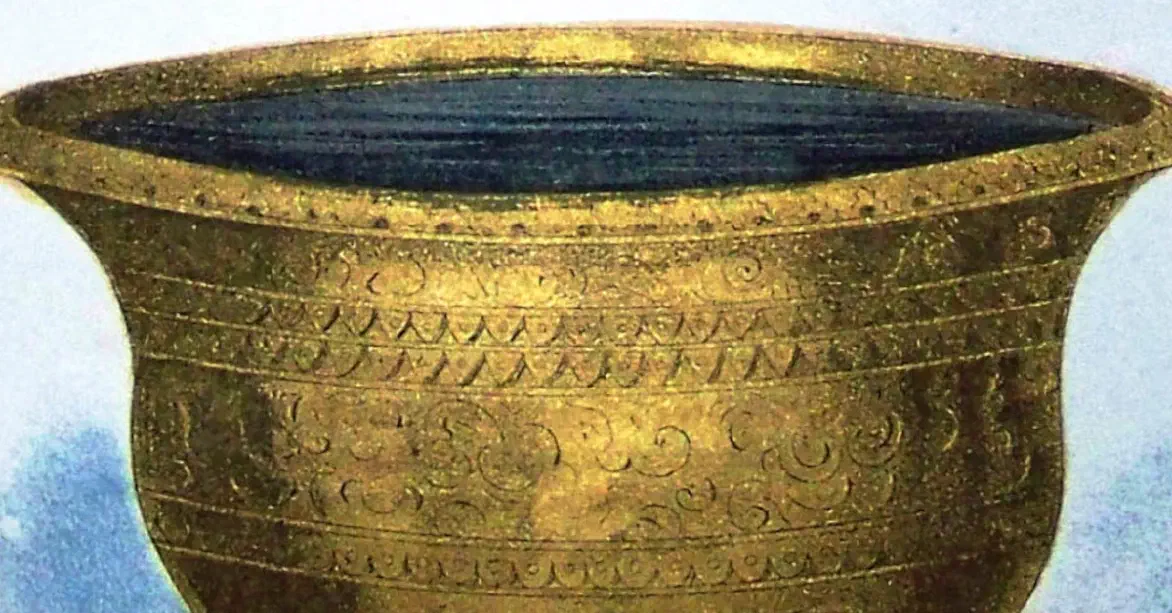
How the Hebrew text of 1 Kings 7:23 encodes Pi to four decimal digits
1 Kings 7:23 describes a circular bronze basin, the molten sea, with a circumference of 30 cubits and a diameter of 10 cubits. The ratio 30/10 gives Pi as exactly 3, which appears to be a mathematical error. The Hebrew text contains a correction. The word for “line” is spelled two different ways in the same verse: קָוֶה (qaveh) followed immediately by קָו (qav). The gematria ratio of these two spellings, applied as a correction factor, yields 3.1415.

The surface problem
And he made a molten sea, ten cubits from the one brim to the other: it was round all about, and his height was five cubits: and a line of thirty cubits did compass it round about. 1 Kings 7:23 KJV
The full Hebrew text of the verse:
וַיַּעַשׂ אֶת־הַיָּם מוּצָק עֶשֶׂר בָּאַמָּה מִשְּׂפָתוֹ עַד־שְׂפָתוֹ עָגֹל סָבִיב וְחָמֵשׁ בָּאַמָּה קוֹמָתוֹ וְקָוֶה וְקָו שְׁלֹשִׁים בָּאַמָּה יָסֹב אֹתוֹ סָבִיבThe two spellings are visible in the text itself: וְקָוֶה (qaveh, with he) followed immediately by וְקָו (qav, without he). The Leningrad Codex marginal note draws attention to this variant, but the observation comes from reading the verse.
Circumference = 30 cubits. Diameter = 10 cubits. 30 / 10 = 3.0.
Pi = 3.14159265…
The discrepancy is substantial. 3.0 versus 3.14159 is a 4.5% error. For a basin approximately 15 feet across, this represents a difference of over two feet in circumference.
The two spellings of “line”
The Hebrew text spells the word for “line” two ways in sequence: קָוֶה (qaveh, with the letter he) then קָו (qav, without it).
Gematria of qaveh:
| Letter | Value |
|---|---|
| ק (qoph) | 100 |
| ו (vav) | 6 |
| ה (he) | 5 |
Total: 111
Gematria of qav:
| Letter | Value |
|---|---|
| ק (qoph) | 100 |
| ו (vav) | 6 |
Total: 106
The correction factor
The ratio of qaveh to qav: 111 / 106 = 1.0471698…
Applied to the circumference: 1.0471698 x 30 = 31.415094
A basin with a diameter of 10 cubits and a circumference of 31.415094 cubits. Divided by the diameter: 31.415094 / 10 = 3.1415094.
Pi = 3.14159265…
The first four decimal digits match: 1, 4, 1, 5. The fifth diverges (result: 0, Pi: 9).
Thirty, Pi, and binary
The Greek word for thirty is τριάκοντα (triakonta). Its isopsephy value is 300 + 100 + 10 + 1 + 20 + 70 + 50 + 300 + 1 = 852.
Beginning at position 852 in the decimal expansion of Pi, the six digits are 101000. The first occurrence of the sequence 852 in Pi is followed by the three digits 110.
In binary, 101000 = 40. In binary, 110 = 6.
Jesus is about thirty years of age when he begins his ministry (Luke 3:23 ). He enters the wilderness for 40 days (Matthew 4:2 ). His ministry ends with 6 hours on the cross (Mark 15:25 , 15:34).
The Greek value of thirty, read through its position in Pi, produces the ministry in binary: 40 days in the wilderness, 6 hours on the cross.