

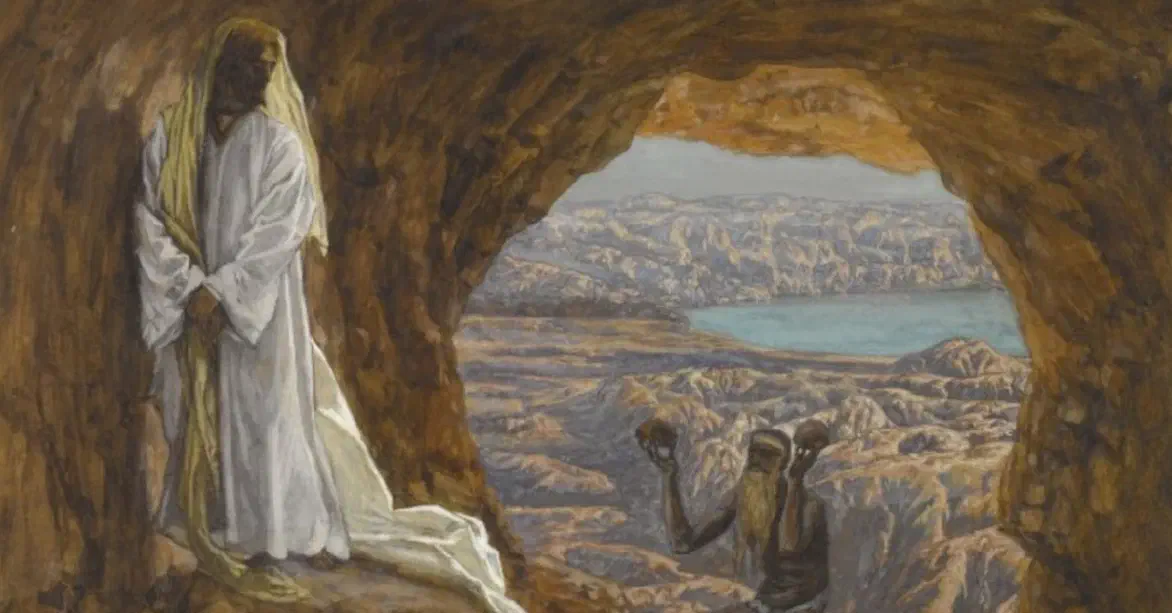
Psalm 91 and the desert temptation
Psalm 91 names four demonic entities by their Canaanite deity names and places them under the authority of four names of God. Satan quotes verses 11-12 in the desert temptation and omits verse 13, the verse that names what he is and announces his defeat. The psalm was used as an exorcism text at Qumran, a weapon against the demonic.

Four names of God in two verses
The psalm opens by naming God four times before naming anything else. Two verses, four titles.
| # | Hebrew | Transliteration | KJV | Verse |
|---|---|---|---|---|
| 1 | עֶלְיוֹן | Elyon | the most High | 91:1 |
| 2 | שַׁדַּי | Shaddai | the Almighty | 91:1 |
| 3 | יהוה | YHWH | the LORD | 91:2 |
| 4 | אֱלֹהַי | Elohay | my God | 91:2 |
“He that dwelleth in the secret place of Elyon shall abide under the shadow of Shaddai. I will say of YHWH, He is my refuge and my fortress: Elohay, in him will I trust.”
Four names packed into the opening. Shaddai appears only twice in all of Psalms (68:14 and 91:1). It is a patriarchal-era name carried from Genesis and Job. The psalm reaches back to the oldest names for God before listing what falls under his authority.
The entities named in verses 3 through 6
The KJV translates these as common nouns: pestilence, terror, destruction. The Hebrew words are names. They are attested as Canaanite deities in Ugaritic texts.
| Verse | Hebrew | Transliteration | KJV | Entity |
|---|---|---|---|---|
| 3, 6 | דֶּבֶר | Deber | pestilence | Plague god, attested in Ugaritic |
| 5 | פַּחַד לָיְלָה | Pachad laylah | terror by night | Night demon (Talmud connects to nocturnal demonic activity) |
| 5 | חֵץ יָעוּף יוֹמָם | chetz ya’uf yomam | arrow that flieth by day | Allusion to Resheph, divine archer and plague god |
| 6 | קֶטֶב | Qeteb | destruction | Kinsman of Mot (death god) in Ugaritic |
Deber appears in verse 3 (“the noisome pestilence”) and again in verse 6 (“the pestilence that walketh in darkness”). Canaanite cultures worshipped Deber as an independent god of plague. The psalm does not treat him as independent. He walks in darkness, but the one who dwells under Shaddai’s shadow has nothing to fear from him.
Resheph is not named explicitly but the image is unmistakable. Resheph was a divine archer who spread plague with his arrows. “The arrow that flieth by day” is his signature. Habakkuk 3:5 confirms the pairing: “Before him went Deber, and Resheph went forth at his feet.” Same two entities, explicitly subordinate to Yahweh.
Pachad laylah, the terror by night. The Babylonian Talmud (Shevuot 15b) identifies this with nocturnal demonic activity. Not ordinary fear. Supernatural dread.
Qeteb, the destruction that wastes at noonday. In Ugaritic, the cognate form is identified as a kinsman of Mot, the Canaanite god of death. The Talmud refers to the “noonday demon” in connection with this verse.
Night and day, darkness and noonday.
What Satan omits
In Matthew 4:6 , Satan quotes Psalm 91:11-12 : “He shall give his angels charge concerning thee: and in their hands they shall bear thee up, lest at any time thou dash thy foot against a stone.”
He stops there. Verse 13 reads:
“Thou shalt tread upon the lion and adder: the young lion and the dragon shalt thou trample under feet.”
| Hebrew | Transliteration | KJV | Connection |
|---|---|---|---|
| שַׁחַל | shachal | lion | 1 Peter 5:8 , the devil as a roaring lion |
| פֶּתֶן | pethen | adder | The nachash, Genesis 3 |
| כְּפִיר | kephir | young lion | Same predator, different form |
| תַּנִּין | tannin | dragon | Revelation 12:9 , Isaiah 27:1 |
Four creatures. Two verbs: tidrokh (תִּדְרֹךְ , “tread upon”) and tirmos (תִּרְמֹס , “trample”). Not avoid. Not resist. Trample.
The lion, the serpent, and the dragon are identifiers for Satan across the canon. 1 Peter 5:8: “your adversary the devil, as a roaring lion, walketh about, seeking whom he may devour.” Revelation 12:9: “the great dragon was cast out, that old serpent, called the Devil, and Satan.” Genesis 3: the nachash in the garden.
Satan quotes the protection. He skips the trampling. He skips the verse that names what he is.
The exchange
Both parties know the text completely.
Jesus was debating teachers of the Law at age twelve. They were astonished at his understanding and answers (Luke 2:46-47 ). Satan has known the text since before it was written. The exchange in the desert follows the rabbinic pattern of quoting scripture against scripture. This was standard practice in disputes over interpretation.
Satan opens three times. He tests whether Jesus knows what is at stake, whether this is the seed of the woman announced in Genesis 3:15 . “If thou be the Son of God” (Matthew 4:3 , 4:6) is not mockery. It is a probe. The third test quotes Psalm 91, the psalm that names Satan’s own subordination and defeat. He quotes the part about angels. He leaves out the part about trampling.
Jesus responds three times. All three from Deuteronomy.
| Test | Satan’s move | Jesus’ response | Reference |
|---|---|---|---|
| 1 | Turn stones to bread | “Man shall not live by bread alone” | Deuteronomy 8:3 |
| 2 | Throw yourself down (Psalm 91:11-12) | “Thou shalt not tempt the Lord thy God” | Deuteronomy 6:16 |
| 3 | Worship me for all kingdoms | “Thou shalt worship the Lord thy God, and him only shalt thou serve” | Deuteronomy 6:13 |
Three verses from Deuteronomy dismantle the entire approach.
The third test is revealing. Satan offers “all the kingdoms of the world, and the glory of them” (Matthew 4:8 ). Jesus does not dispute that they are Satan’s to offer. Scripture confirms the claim. Jesus calls him “the prince of this world” (John 12:31 , 14:30, 16:11). Paul calls him “the god of this world” (2 Corinthians 4:4 ). The offer is legitimate. The price is worship. Jesus refuses the price, not the premise.
The exorcism psalm
Dead Sea Scroll 11Q11 (copied c. 50-68 AD) contains four psalms used for exorcism. The first three are compositions found nowhere else. The fourth is Psalm 91, the canonical psalm, placed directly into an exorcism liturgy.
The Babylonian Talmud (Shevuot 15b) calls Psalm 91 shir shel pega’im (שיר של פגעים ), “a song for evil spirits.”
This is how Second Temple Jews read the psalm: a weapon against unclean spirits.
It is still used in deliverance ministry today. The demons still respond to it.
References
- Babylonian Talmud, Shevuot 15b: Pachad laylah connected to nocturnal demonic activity; Psalm 91 called shir shel pega’im (a song for evil spirits).
- Dead Sea Scroll 11Q11 (c. 50-68 AD): Psalm 91 as the fourth text in a Second Temple exorcism liturgy.
- Michael S. Heiser, on Psalm 91 (video interview, c. 2020): the threats of Psalm 91:5-6 (Pachad laylah, Deber, Qeteb, and the arrow that flies by day) as names and epithets of Canaanite deities.
- KTU 1.82 (Ugaritic incantation text): Resheph named as divine archer, parallel to Psalm 91’s arrow that flies by day.