

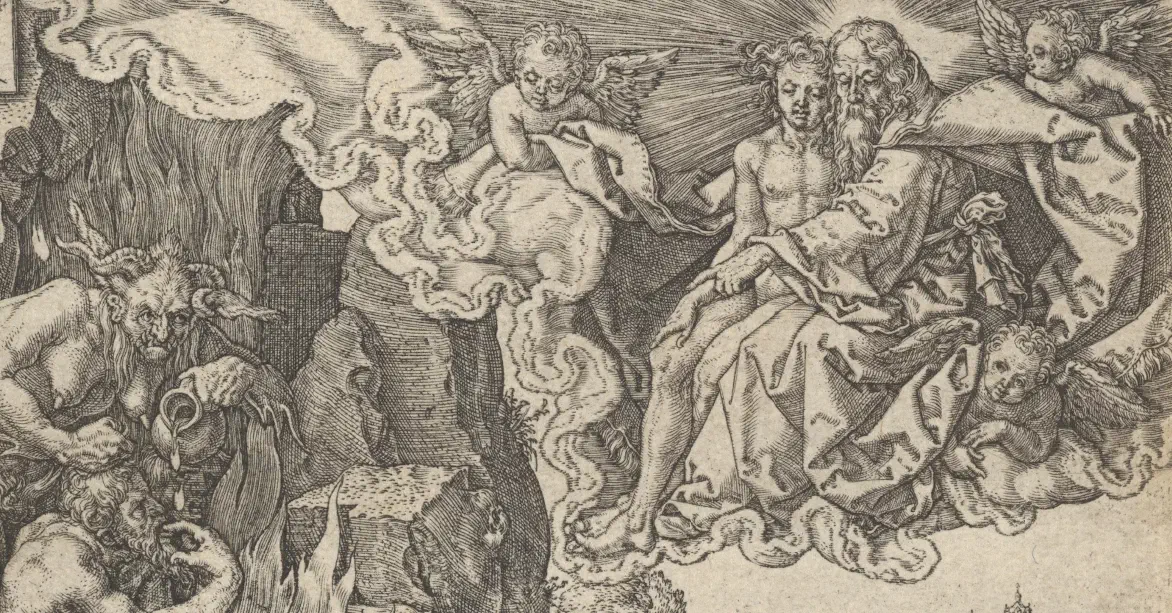
Sheol Hades Gehenna and Tartarus are not the same place
Four different words in the biblical text are translated as “hell” in English. Sheol (שְׁאוֹל ) is the Hebrew realm of all the dead. Hades (ᾅδης ) is its Greek equivalent. Gehenna (γέεννα ) is the Valley of Hinnom outside Jerusalem. Tartarus (ταρταρόω ) appears once, for a specific prison of fallen angels. These are four distinct locations with different characteristics, different populations, and different durations. Translating all four as “hell” produces contradictions the original languages avoid.

Sheol
שְׁאוֹל (Sheol) appears throughout the Hebrew Old Testament. The KJV translates it inconsistently as “hell,” “grave,” and “pit.” The Hebrew word is the same in every instance.
Sheol is where all the dead go.
Genesis 37:35 : Jacob mourning Joseph says, “I will go down into the grave (Sheol) unto my son mourning.” He is expecting to join his dead son in the realm of the departed.
Psalm 16:10 : “For thou wilt not leave my soul in hell (Sheol); neither wilt thou suffer thine Holy One to see corruption.” David (and prophetically, the Messiah) expects to enter Sheol but not remain there. Acts 2:27 quotes this verse in Greek using Hades.
Ecclesiastes 9:10 : “There is no work, nor device, nor knowledge, nor wisdom, in the grave (Sheol), whither thou goest.” Solomon describes Sheol as a place of inactivity, not torment.
Isaiah 14:9-10 portrays Sheol differently: “Hell (Sheol) from beneath is moved for thee to meet thee at thy coming: it stirreth up the dead for thee.” Here the dead in Sheol are conscious, capable of speech, and aware of new arrivals. This passage describes the king of Babylon arriving in Sheol and being mocked by those already there.
The Old Testament portrait of Sheol is consistent: it is below (Num 16:30-33 ), it receives all the dead (Ps 89:48 ), the dead there are called rephaim (רְפָאִים , “shades, weakened ones”), and it is distinct from the abode of God (Ps 139:8 ).
Sheol’s two compartments
Luke 16:19-31 (the account of the rich man and Lazarus) describes Hades as having two regions separated by a “great gulf fixed” (Luke 16:26 ). Abraham’s bosom is the comfortable side. The place of torment is the other. Both are within Hades. This matches the rabbinic concept of Sheol having divisions for the righteous and the wicked.
Whether this is a parable or a literal account is debated, but the geography described is consistent with the Old Testament data: all the dead go to the same general realm, but conditions within it differ.
Hades
ᾅδης (Hades) is the direct equivalent of Sheol. The Septuagint consistently translates Sheol as Hades.
Matthew 16:18 : “The gates of hell (Hades) shall not prevail against it.” Gates are defensive structures. Jesus describes Hades as a fortified place that will not be able to hold against the church.
Revelation 1:18 : “I am he that liveth, and was dead; and, behold, I am alive for evermore, Amen; and have the keys of hell (Hades) and of death.” Jesus holds the keys to Hades, implying authority to release those held there.
Revelation 20:13-14 : “And death and hell (Hades) delivered up the dead which were in them… And death and hell (Hades) were cast into the lake of fire.”
This last verse is decisive. Hades is thrown into the lake of fire. Hades is temporary. The lake of fire is the final state. Translating both as “hell” collapses a sequence into a contradiction.
Gehenna
γέεννα (Gehenna) appears 12 times in the New Testament: 11 times spoken by Jesus and once by James (3:6). It is the Greek transliteration of the Hebrew ge-hinnom (גֵּי הִנֹּם , “Valley of Hinnom”), a real valley on the south side of Jerusalem.
The history of the Valley of Hinnom
2 Chronicles 28:3 : “Moreover he [Ahaz] burnt incense in the valley of the son of Hinnom, and burnt his children in the fire, after the abominations of the heathen.” The valley was used for child sacrifice to Molech (מֹלֶךְ ).
2 Kings 23:10 : “And he [Josiah] defiled Topheth, which is in the valley of the children of Hinnom, that no man might make his son or his daughter to pass through the fire to Molech.” Josiah desecrated the site to prevent further sacrifices.
Jeremiah 7:31-32 : “And they have built the high places of Tophet, which is in the valley of the son of Hinnom, to burn their sons and their daughters in the fire… Therefore, behold, the days come, saith the LORD, that it shall no more be called Tophet, nor the valley of the son of Hinnom, but the valley of slaughter.”
By the first century, the valley served as Jerusalem’s refuse dump, where fires burned continuously to consume waste. The association with child sacrifice, fire, and destruction made it the natural reference point for a place of judgment.
Jesus’ use of Gehenna
Mark 9:43-44 : “And if thy hand offend thee, cut it off: it is better for thee to enter into life maimed, than having two hands to go into hell (Gehenna), into the fire that never shall be quenched: Where their worm dieth not, and the fire is not quenched.”
Jesus is quoting Isaiah 66:24 : “And they shall go forth, and look upon the carcases of the men that have transgressed against me: for their worm shall not die, neither shall their fire be quenched; and they shall be an abhorring unto all flesh.”
Isaiah describes corpses being consumed, not living souls being tortured. The fire and worms are agents of destruction, not preservation. Jesus uses the same imagery with the same referent: Gehenna is a place of destruction, not eternal conscious torment.
Matthew 10:28 : “Fear not them which kill the body, but are not able to kill the soul: but rather fear him which is able to destroy both soul and body in hell (Gehenna).” The verb is apollymi (ἀπολέσαι , “to destroy utterly”). The text says destroy, not torment.
Tartarus
ταρταρώσας (tartarosas) appears exactly once in the New Testament.
2 Peter 2:4 : “For if God spared not the angels that sinned, but cast them down to hell (tartarosas), and delivered them into chains of darkness, to be reserved unto judgment.”
The verb form is an aorist participle of tartaroo (ταρταρόω , “to cast into Tartarus”). In Greek mythology, Tartarus was the deepest region of the underworld, below Hades, reserved for the Titans. Peter borrows the term for a specific holding place for fallen angels.
Jude 1:6 describes the same event without using the word Tartarus: “And the angels which kept not their first estate, but left their own habitation, he hath reserved in everlasting chains under darkness unto the judgment of the great day.”
Tartarus is a prison for a specific group of angelic beings who transgressed a specific boundary. The context in both 2 Peter and Jude connects these angels to the events of Genesis 6:1-4 , where the bene ha-elohim (בְּנֵי הָאֱלֹהִים , “sons of God”) took human wives.
The four locations compared
| Term | Language | Who goes there | Duration | Nature |
|---|---|---|---|---|
| Sheol | Hebrew | All the dead | Until resurrection | Realm of the departed |
| Hades | Greek | All the dead | Thrown into lake of fire (Rev 20:14 ) | Greek equivalent of Sheol |
| Gehenna | Greek (from Hebrew) | Those judged by God | Associated with final judgment | Destruction by fire |
| Tartarus | Greek | Fallen angels | Until the great day of judgment | Prison in chains of darkness |
The translation problem
The KJV translates Sheol as “hell” 31 times and as “grave” 31 times with no consistent rule governing the choice. The same Hebrew word receives two different English translations depending on context, which means the translators were interpreting rather than translating.
When Sheol, Hades, Gehenna, and Tartarus all become “hell,” the reader loses the distinction between the temporary holding place of all the dead (Sheol/Hades), the place of final destruction (Gehenna), and the angelic prison (Tartarus). Doctrinal contradictions the original languages avoid appear in English because four distinct concepts have been merged into one word.