

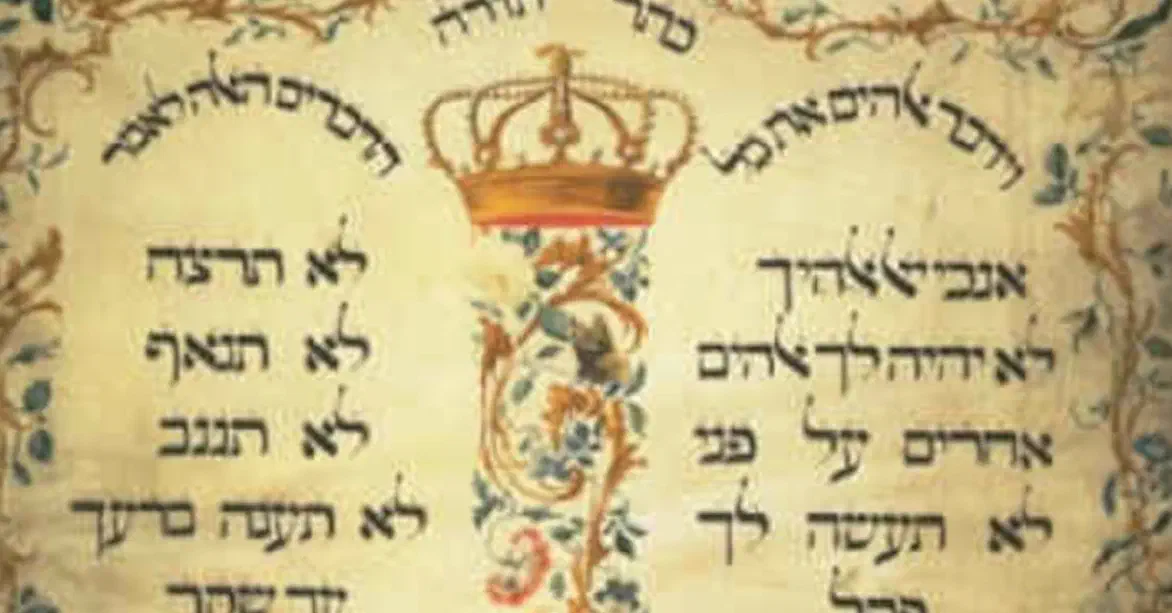
The Ten Commandments are a covenant document not a list of rules
The Hebrew phrase translated “Ten Commandments” is aseret hadibrot (עֲשֶׂרֶת הַדִּבְּרוֹת , “ten words”). The word dibrot is the plural of dibbrah (דִּבְּרָה , “utterance”), from the root d-b-r, the same root behind davar (דָּבָר , “word, thing, matter”). The term does not derive from tsavah (צָוָה , “to command”). The structure of the ten words follows the suzerain-vassal treaty format of the ancient Near East: the greater king identifies himself, recounts what he has done, then establishes the terms of the relationship.

The treaty structure
Ancient suzerain-vassal treaties followed a fixed pattern documented across Hittite, Akkadian, and Egyptian sources. The pattern consists of six elements:
- Preamble: identification of the suzerain
- Historical prologue: what the suzerain has done for the vassal
- Stipulations: the terms of the relationship
- Provision for deposit and reading: where the document is stored
- Witnesses: who testifies to the covenant
- Blessings and curses: consequences of keeping or breaking the terms
Exodus 20 maps onto this structure precisely.
Preamble: “I am the LORD thy God” (Exodus 20:2a ). The suzerain identifies himself by name: יְהוָה (YHWH).
Historical prologue: “which have brought thee out of the land of Egypt, out of the house of bondage” (Exodus 20:2b). The suzerain recounts his action on behalf of the vassal.
Stipulations: the ten words themselves (Exodus 20:3-17 ).
Deposit: the tablets are placed in the Ark of the Covenant (Deuteronomy 10:5 ), the covenant container kept in the most sacred space.
Witnesses: heaven and earth (Deuteronomy 30:19 ).
Blessings and curses: Deuteronomy 28.
The first four and the last six
The ten words divide into two groups. The first four address the relationship between God and Israel. The last six address relationships between Israelites. This division maps onto the two tablets: four and six rather than the five-and-five split of common depictions.
The first word, “Thou shalt have no other gods before me,” is a treaty exclusivity clause. The vassal may not enter into covenant with another suzerain. The word elohim (אֱלֹהִים , “gods, divine beings”) in this context refers to the members of the divine council described in Psalm 82 and Deuteronomy 32:8. The prohibition is against covenant allegiance to other divine beings who were allotted to the nations. Their existence is assumed by the text.
The gematria of the first verse
The opening declaration אָנֹכִי יְהוָה אֱלֹהֶיךָ (“I am the LORD your God”) has the following values:
| Word | Hebrew | Value |
|---|---|---|
| Anokhi | אָנֹכִי | 1 + 50 + 20 + 10 = 81 |
| YHWH | יְהוָה | 10 + 5 + 6 + 5 = 26 |
| Elohekha | אֱלֹהֶיךָ | 1 + 30 + 5 + 10 + 20 = 66 |
81 + 26 + 66 = 173. 173 is the 40th prime. Israel spent 40 years in the wilderness and Moses spent 40 days on the mountain.