

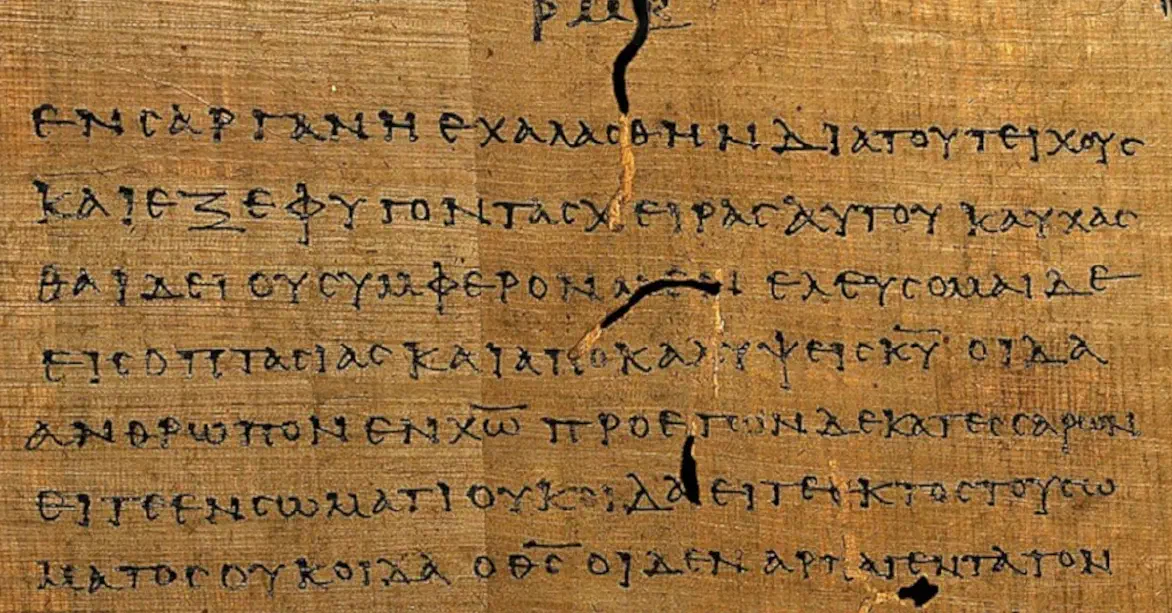
What the six pieces of the armor of God mean in Hebrew and Greek
Ephesians 6:14-17 names six pieces of armor: truth, righteousness, the gospel of peace, faith, salvation, and the word of God. Every one of the six is a Greek noun with a Hebrew root behind it, and two of the six are pieces God himself puts on in Isaiah 59:17 . The letter that contains the list splits in two halves: chapters 1-3 state what the believer is in Christ, chapters 4-6 apply it, and the armor is that application under fire. The equipment exists for the evil day, the day of total assault, and its one offensive piece is the spoken word. Prayer follows the list in Ephesians 6:18 with no armor piece attached to it; it accompanies all six.

The letter splits in two
Chapters 1-3 state the position. The believer is blessed “with all spiritual blessings in heavenly places in Christ” (Ephesians 1:3 ). Christ sits “far above all principality, and power, and might, and dominion, and every name that is named” (Ephesians 1:20-21 ), and the believer is “raised up together” and made to “sit together in heavenly places in Christ Jesus” (Ephesians 2:6 ). Chapter 3 gives the direction of the arrangement: “unto the principalities and powers in heavenly places might be known by the church the manifold wisdom of God” (Ephesians 3:10 ). The church is the demonstration to the roster it later wrestles.
Chapters 4-6 apply the position: “walk worthy of the vocation wherewith ye are called” (Ephesians 4:1 ). The application ends in a wrestle, and its final paragraph opens “Finally, my brethren, be strong in the Lord, and in the power of his might” (Ephesians 6:10 ).
The vocabulary ties the halves together. Archē (ἀρχή , “principality”) and exousia (ἐξουσία , “authority”) appear in 1:21, 3:10, and 6:12 . Epouranios (ἐπουράνιος , “heavenly”) carries 1:3, 1:20, 2:6, 3:10, and 6:12. Chapter 6 engages the same roster in the same places where the believer is already seated.
The armor God wears
The equipment list is older than the letter. Isaiah 59 watches for a man and an intercessor and finds none: “therefore his arm brought salvation unto him; and his righteousness, it sustained him” (Isaiah 59:16 ). Then comes the clothing: “For he put on righteousness as a breastplate, and an helmet of salvation upon his head” (Isaiah 59:17). God wears the breastplate and the helmet before any believer is told to take them up. Isaiah gives the Messiah the girdle as well: “And righteousness shall be the girdle of his loins, and faithfulness the girdle of his reins” (Isaiah 11:5 ). Paul states the transfer in one instruction: “put ye on the Lord Jesus Christ” (Romans 13:14 ).
| Piece | Verse | Greek | Hebrew | Drawn from |
|---|---|---|---|---|
| Belt | Eph 6:14 | alētheia, truth | emet | Isa 11:5 |
| Breastplate | Eph 6:14 | dikaiosynē, righteousness | tsedaqah | Isa 59:17 |
| Shoes | Eph 6:15 | euangelion, gospel; eirēnē, peace | besorah, shalom | Isa 52:7 |
| Shield | Eph 6:16 | pistis, faith | emunah | Gen 15:1 |
| Helmet | Eph 6:17 | sōtērion, salvation | yeshuah | Isa 59:17 |
| Sword | Eph 6:17 | rhēma, word | davar | Matt 4:4 |
Truth: the belt
“Stand therefore, having your loins girt about with truth” (Ephesians 6:14). The Hebrew is emet (אֱמֶת , “truth”), built on the root aman (אָמַן ): firm, able to carry weight. The same root produces “amen” and emunah, the faith-word of the shield. The Greek is alētheia (ἀλήθεια , “truth”), the privative a- with lanthanō (λανθάνω , “to be hidden”): what is no longer concealed. Truth in Hebrew is what holds; truth in Greek is what is uncovered. “thy word is truth” (John 17:17 ).
Girded loins mark readiness for work and movement: the Passover eaten “with your loins girded” (Exodus 12:11 ), Elijah who “girded up his loins, and ran” (1 Kings 18:46 ), and Peter’s transfer of the picture, “gird up the loins of your mind” (1 Peter 1:13 ). A soldier’s belt gathered the tunic for movement and carried the scabbard: the sword of verse 17 hangs on the truth of verse 14.
Righteousness: the breastplate
“And having on the breastplate of righteousness” (Ephesians 6:14). The Hebrew is tsedaqah (צְדָקָה , “righteousness”), from tsedeq (צֶדֶק , “what is straight”): what measures right. The Greek is dikaiosynē (δικαιοσύνη , “righteousness”), from dikē (δίκη , “judgment”): the standing of the one declared right. The breastplate covers the heart and the organs around it; the righteousness that does the covering is received: “that we might be made the righteousness of God in him” (2 Corinthians 5:21 ).
Peace: the shoes
“And your feet shod with the preparation of the gospel of peace” (Ephesians 6:15). The peace-word is shalom (שָׁלוֹם , “peace”), from shalem (שָׁלֵם ): whole, complete. The tidings-word is basar (בָּשַׂר , “to bring good news”), whose noun besorah (בְּשׂוֹרָה , “good news”) is what Greek renders euangelion (εὐαγγέλιον , “gospel”). Isaiah holds both in one verse: “How beautiful upon the mountains are the feet of him that bringeth good tidings, that publisheth peace” (Isaiah 52:7 ), and continues “that publisheth salvation”, the helmet’s word. Paul adds hetoimasia (ἑτοιμασία , “preparation, readiness”) and eirēnē (εἰρήνη , “peace”): readiness to move, and wholeness as the message carried.
Faith: the shield
“Above all, taking the shield of faith, wherewith ye shall be able to quench all the fiery darts of the wicked” (Ephesians 6:16). The Hebrew is emunah (אֱמוּנָה , “faith”), from the same root as emet: “the just shall live by his faith” (Habakkuk 2:4 ). The belt and the shield share a root; faith is truth relied upon. The Greek is pistis (πίστις , “faith”), from peithō (πείθω , “to persuade”): persuaded trust.
The shield-word is thureos (θυρεός , “large shield”), from thura (θύρα , “door”): the door-sized body shield that covers the whole man. The first shield in Scripture is a person: “Fear not, Abram: I am thy shield, and thy exceeding great reward” (Genesis 15:1 , the law of first mention). Psalm 91 assigns the cover: “his truth shall be thy shield and buckler” (Psalm 91:4 ), truth carrying the man behind it.
Salvation: the helmet
“And take the helmet of salvation” (Ephesians 6:17). The Hebrew is yeshuah (יְשׁוּעָה , “salvation”), from yasha (יָשַׁע , “to save”): rescue into room. “He brought me forth also into a large place; he delivered me, because he delighted in me” (Psalm 18:19 ). The name Yeshua (יֵשׁוּעַ ) is built on this root. The Greek is sōtērion (σωτήριον , “salvation”), the word Simeon used with the child in his arms: “mine eyes have seen thy salvation” (Luke 2:30 ).
Writing to the Thessalonians, Paul pairs the same equipment differently: “putting on the breastplate of faith and love; and for an helmet, the hope of salvation” (1 Thessalonians 5:8 ).
The word: the sword
“And the sword of the Spirit, which is the word of God” (Ephesians 6:17). The Hebrew is davar (דָּבָר , “word”): a word that is also the deed it names, speech with substance. The Greek is rhēma (ῥῆμα , “uttered word”), the spoken unit, where logos (λόγος ) would be the collected word. The sword of the Spirit is a specific sentence of God, spoken into a specific moment. The blade-word is machaira (μάχαιρα , “short sword”), the close-quarters weapon, matching the wrestling of verse 12. Hebrews uses machaira for the word itself: “sharper than any twoedged sword” (Hebrews 4:12 ).
In the desert, Jesus answers each of the three temptations with a quoted sentence introduced by “It is written” (Matthew 4:4 ), and the word in his answer is rhēma: “by every word that proceedeth out of the mouth of God”. The written text, spoken aloud against the specific lie, is the sword in use (the full study: Psalm 91 and the desert temptation).
The evil day
The armor has a specified day: “that ye may be able to withstand in the evil day, and having done all, to stand” (Ephesians 6:13 ). Stand runs four times through the paragraph: “able to stand against the wiles of the devil” (Ephesians 6:11 ), withstand, having done all to stand, stand therefore. Methodeia (μεθοδεία , “wiles, methods”) is what the standing answers: the devil works by methods, and the panoplia (πανοπλία , “full armor”), the whole armor of verse 11, answers all of them.
The struggle is palē (πάλη , “wrestling”): hand-to-hand, at the closest range. The roster on the other side is the one mapped in the Deuteronomy 32 worldview: “principalities… powers… the rulers of the darkness of this world… spiritual wickedness in high places” (Ephesians 6:12), where rulers renders kosmokratōr (κοσμοκράτωρ , “world-ruler”). The issued equipment covers the front entirely; nothing is assigned to the back. Of the six pieces, one is offensive, and it stays in hand when the day is a total disaster.
Prayer, the bonus
The list ends, and the next verse begins “Praying always with all prayer and supplication in the Spirit, and watching thereunto with all perseverance and supplication for all saints” (Ephesians 6:18). No armor piece is attached to it. Two nouns carry it: proseuchē (προσευχή , “prayer”), the toward-God word, and deēsis (δέησις , “supplication”), the petition of need. Its timing is “always”, its location is “in the Spirit”, its scope is “for all saints”.
Paul then requests the thing for himself: “that utterance may be given unto me, that I may open my mouth boldly” (Ephesians 6:19-20 ). The man writing the equipment list is “an ambassador in bonds”, and what he asks the saints to pray for is utterance and boldness to speak.