

Every time God writes in the Bible it is judgment
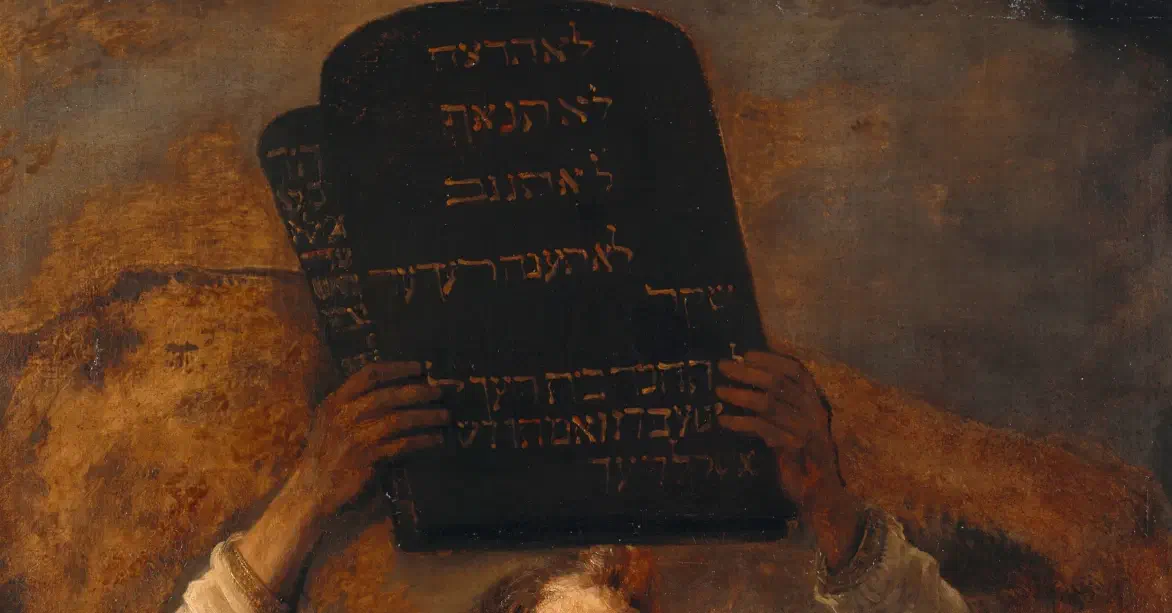
God writes between three and five times in Scripture, depending on how the events at Sinai and Jerusalem are counted. Every instance follows the same sequence: man profanes what belongs to God, God responds by writing, and judgment follows. The word “finger” connects Sinai (Exodus 31:18 , “finger of God”), Babylon (Daniel 5:5 , “fingers of a man’s hand”), and Jerusalem (John 8:6 , “with his finger”) across more than a thousand years of biblical history.

Sinai: the first tablets
And he gave unto Moses, when he had made an end of communing with him upon mount Sinai, two tables of testimony, tables of stone, written with the finger of God. Exodus 31:18 KJV
The Hebrew phrase is etsba Elohim (אֶצְבַּע אֱלֹהִים , “finger of God”). Exodus 32:16 confirms the authorship: “the tables were the work of God, and the writing was the writing of God, graven upon the tables.” Moses’ account in Deuteronomy 9:10 repeats the phrase: “written with the finger of God.”
The tablets contained the aseret hadibrot (עֲשֶׂרֶת הַדִּבְּרוֹת , “ten words”), what English translations call the Ten Commandments. The word dibrot is the plural of dibbrah (דִּבְּרָה , “utterance”), from the root d-b-r. The same root appears in Psalm 33:6 as davar (דָּבָר , “word”) for God’s creative speech (“By the word of the LORD were the heavens made”). These are ten utterances spoken and then written in stone by the same author.
While Moses was on the mountain receiving these tablets, Israel was at the base worshipping a golden calf (Exodus 32:1-6 ). The first commandment on the tablets reads:
Thou shalt have no other gods before me. Exodus 20:3 KJV
The Hebrew: לא יהיה לך אלהים אחרים על פני
In the script of Moses’ era, the Proto-Sinaitic alphabet, this commandment looked nothing like modern Hebrew. The letters were still pictographic, derived from Egyptian hieratic signs.
Moses came down, saw the calf, and broke the tablets (Exodus 32:19 ). Three thousand men died that day (Exodus 32:28 ). The commandment they were violating was written by the finger of God on the stones Moses smashed at the foot of the mountain.
Sinai: the second tablets
God wrote a second time. Exodus 34:1 : “I will write upon these tables the words that were in the first tables, which thou brakest.” Deuteronomy 10:4 confirms the execution:
And he wrote on the tables, according to the first writing, the ten commandments, which the Lord spake unto you in the mount out of the midst of the fire in the day of the assembly: and the Lord gave them unto me. Deuteronomy 10:4 KJV
God wrote both times.
Babylon: the wall
In the same hour came forth fingers of a man’s hand, and wrote over against the candlestick upon the plaister of the wall of the king’s palace: and the king saw the part of the hand that wrote. Daniel 5:5 KJV
The phrasing shifts. Sinai says “finger of God” (אֶצְבַּע אֱלֹהִים ). Daniel says “fingers of a man’s hand.” But Daniel 5:24 identifies the sender: “Then was the part of the hand sent from him,” referring to the God whom Belshazzar had just defied.
What triggered the writing
Belshazzar did not simply throw a feast. He ordered the gold and silver vessels looted from the Temple in Jerusalem to be brought out (Daniel 5:2-3 ). The guests drank from God’s vessels and “praised the gods of gold, and of silver, of brass, of iron, of wood, and of stone” (Daniel 5:4 ). The hand appeared in the same hour.
Daniel spells out the charge:
But hast lifted up thyself against the Lord of heaven; and they have brought the vessels of his house before thee, and thou, and thy lords, thy wives, and thy concubines, have drunk wine in them; and thou hast praised the gods of silver, and gold, of brass, iron, wood, and stone, which see not, nor hear, nor know: and the God in whose hand thy breath is, and whose are all thy ways, hast thou not glorified: Daniel 5:23 KJV
What the wall said
The writing is Aramaic. Daniel 2:4 through 7:28 is written entirely in Aramaic, the administrative language of the Babylonian and Persian empires.
The reason Belshazzar’s wise men could not interpret the writing is linguistic. The consonants naturally read as weight nouns: a mina, a mina, a shekel, and half-minas. These units appear hundreds of times in Aramaic administrative documents. Reading them as weights produces a list: “one mina, one mina, one shekel, half-minas.” A ledger entry on a palace wall. The wise men read the common meaning and found nonsense.
Daniel read the verbal roots behind the nouns:
| Wall | Noun (weight) | Verbal root | Daniel’s reading (Daniel 5:26-28 ) |
|---|---|---|---|
| מנא | mina (~60 shekels) | mena (מנה, “to number”) | God has numbered your kingdom and finished it |
| תקל | shekel | teqal (תקל, “to weigh”) | You are weighed in the balances and found wanting |
| פרס | half-mina | peras (פרס, “to divide”) | Your kingdom is divided and given to the Medes and Persians |
The last word carries a triple layer. As a noun: a half-mina. As a verb: divided. As a proper noun: פרס (Paras), Persia. The empire that would conquer Babylon that very night is encoded in the word for its destruction.
The roots are Aramaic
All three verbal roots belong to Aramaic. Two of them (mena and peras) also exist in Hebrew with the same meaning, since both languages share common Semitic roots. The third, teqal, is distinctly Aramaic. The Hebrew verb for “to weigh” is shaqal (שקל , Strong’s 8254), the root behind the word “shekel.” The Aramaic form teqal (Strong’s 8625) is classified as Aramaic in every standard lexicon. Daniel’s interpretation operates entirely within Aramaic, reading Aramaic verbal roots from Aramaic nouns in an Aramaic text.
The passive participle forms that Daniel read are extremely rare. Gzella’s analysis of first-millennium Aramaic documents found that the passive participles of these three verbs appear no more than once each across the surviving corpus. The noun forms appear hundreds of times. The wise men defaulted to the reading they had seen a thousand times. Daniel read the one they had never encountered.
The Talmud on why it was unreadable
The Talmud (Sanhedrin 22a ) preserves three additional theories for why the wise men failed:
- Rav: the writing used a numerical cipher (gematria substitution)
- Shmuel: the words were written vertically instead of right-to-left
- Rav Ashi: the first two letters of each word were transposed
These traditions address the same problem from different angles. Whether the difficulty was the script, the orientation, or the grammar, the text required someone who could read what God actually wrote, not what the surface appeared to say.
Rav does not specify which numerical system was used. Multiple gematria systems existed in antiquity. For reference, the standard gematria used across this site yields the following values for the consonants on the wall:
| Word | Aramaic | Values | Sum |
|---|---|---|---|
| MENE | מנא | 40 + 50 + 1 | 91 |
| MENE | מנא | 40 + 50 + 1 | 91 |
| TEKEL | תקל | 400 + 100 + 30 | 530 |
| UPHARSIN | ופרסין | 6 + 80 + 200 + 60 + 10 + 50 | 406 |
Total: 1118.
Jerusalem: the ground
This they said, tempting him, that they might have to accuse him. But Jesus stooped down, and with his finger wrote on the ground, as though he heard them not. John 8:6 KJV
And again he stooped down, and wrote on the ground. John 8:8 KJV
The Greek is explicit about the finger: tō daktylō (τῷ δακτύλῳ, “with the finger”). John records two separate acts of writing (v6 and v8). The text does not record what Jesus wrote.
The setting is the Temple (John 8:2 ). The Pharisees bring a woman caught in adultery and cite the law of Moses: “Moses in the law commanded us, that such should be stoned: but what sayest thou?” (John 8:5 ).
The law they cite (Leviticus 20:10 , Deuteronomy 22:22 ) requires the death of both parties. They brought the woman. The man is absent. They are using the law of Moses as a weapon while violating its own terms.
At Sinai, Israel worshipped other gods. In Babylon, Belshazzar profaned Temple vessels while praising other gods. In Jerusalem, the Pharisees weaponized God’s law while perverting its requirements. The pattern holds: man profanes what belongs to God, God writes.
What Jesus may have written
The text never says. Speculation has filled the gap for two thousand years. Roy Blizzard (Understanding the Difficult Words of Jesus, co-authored with David Bivin) proposed a specific connection: Jeremiah 17:13 .
O Lord, the hope of Israel, all that forsake thee shall be ashamed, and they that depart from me shall be written in the earth, because they have forsaken the Lord, the fountain of living waters. Jeremiah 17:13 KJV
The Hebrew clause: vesuray ba’aretz yikkatvu (וסורי בארץ יכתבו , “and they that depart from me shall be written in the earth”).
If Blizzard’s reading is correct, the verb yikkatvu (“shall be written”) describes the act Jesus was performing at the moment he performed it. Jesus writes in the earth while the text says those who forsake the Lord shall be written in the earth. The Pharisees, scholars who memorized the prophets, would have recognized the passage immediately.
This is Blizzard’s observation, presented here as such. The text of John 8 does not confirm or deny it. What the text does confirm is that Jesus wrote with his finger on the ground, that the setting was the Temple, that the accusers left one by one beginning with the eldest, and that he wrote twice.
The pattern
Three locations. One author. Every instance follows the same sequence.
| Sinai | Babylon | Jerusalem | |
|---|---|---|---|
| When | c. 1446 BC* | 539 BC* | c. AD 30* |
| Where | The mountain of God | A pagan palace (with Temple vessels present) | The Temple grounds |
| The profanation | Israel worships a golden calf | Belshazzar drinks from Temple vessels, praises other gods | Pharisees weaponize God’s law while violating it |
| The writing | “finger of God” (Exodus 31:18) | “fingers of a man’s hand” (Daniel 5:5) | “with his finger” (John 8:6) |
| What was written | The ten words (commandments) | MENE, MENE, TEKEL, UPHARSIN | Unknown |
| The result | Tablets broken, 3,000 die | Belshazzar dies that night, kingdom falls | Accusers leave, woman forgiven |
*Conventional scholarly dates. These conflict with the biblical chronology in Age of the earth with years provided by the Bible.
The script changes across the centuries. The tablets at Sinai were written in a script ancestral to the Paleo-Hebrew alphabet. The wall in Babylon was written in Aramaic, the administrative script of the empire. John records the event in Jerusalem in Koine Greek. The writing moves from stone to plaster to earth. From pictographic letters to square consonants to a text that never records what was written at all.
What stays constant is the finger, the profanation that precedes it, and the judgment that follows.
References
- Roy Blizzard and David Bivin, Understanding the Difficult Words of Jesus: proposed connection between Jesus writing on the ground and Jeremiah 17:13.
- Holger Gzella (Professor of Hebrew and Aramaic, Leiden University), “The Scribal Background of the ‘Menetekel’ in Daniel 5,” bibleinterp.arizona.edu (2016): Aramaic weight nouns vs. rare passive participles as the linguistic basis for the dual reading.
- Babylonian Talmud, Sanhedrin 22a : three theories for why the writing on the wall was unreadable (gematria cipher, vertical orientation, transposed letters).