

The initial answer is no
God tests persistence, and the clearest examples involve intercession: someone asking on behalf of another. A Canaanite woman asks Jesus to heal her daughter and the first answer is silence. The second is a statement of covenantal priority. The third compares her to a dog. She holds her ground, accepts the premise, and argues within it. Jesus commends her faith. The friend at midnight asks for bread because his guest has nothing to eat. Abraham negotiates with God for the righteous in Sodom. In each case someone stands in the gap for someone else, and the initial answer is no. The widow before the unjust judge and Jacob wrestling at Peniel complete the pattern with personal petitions. Across all five cases the principle is the same: the refusal is the test, and one-time requests do not pass it.

The woman of Canaan
Matthew calls her “a woman of Canaan” (Matthew 15:22 ). Mark calls her “a Greek, a Syrophenician by nation” (Mark 7:26 ). Matthew uses the older, loaded term. Canaan is the cursed line (Genesis 9:25 ). She has every covenantal reason to be told no.
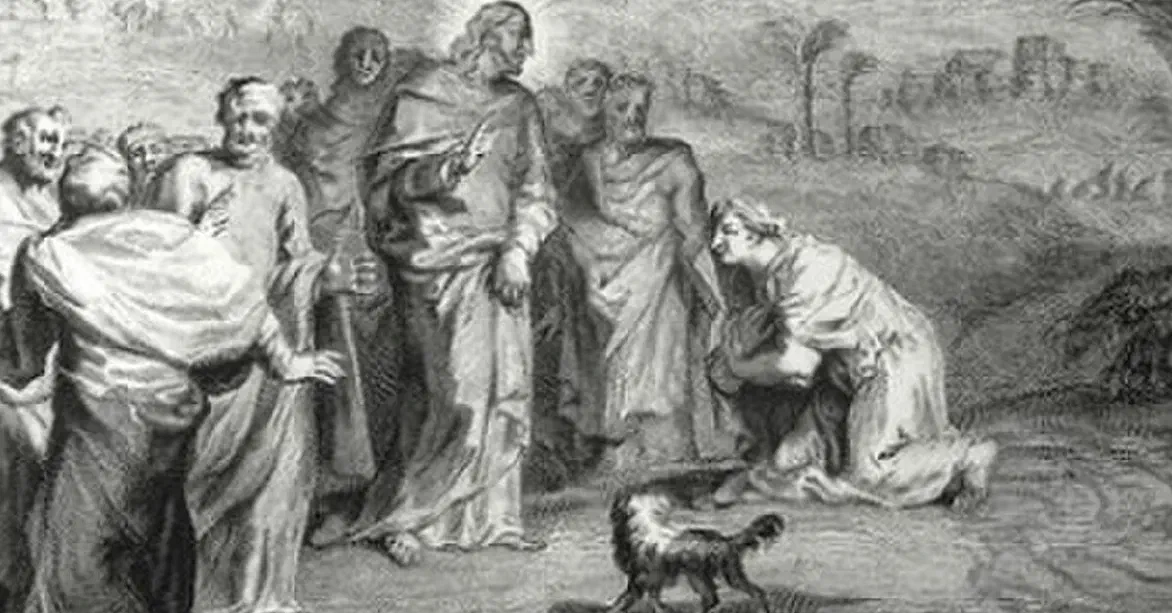
She comes to Jesus on behalf of her daughter, who is “grievously vexed with a devil” (Matthew 15:22). She asks nothing for herself. His response is silence. “He answered her not a word” (Matthew 15:23 ). The disciples want her sent away. Jesus then states his mission boundary: “I am not sent but unto the lost sheep of the house of Israel” (Matthew 15:24 ).
She worships him and says three words: “Lord, help me” (Matthew 15:25 ).
Jesus answers with the hardest line in the exchange: “It is not meet to take the children’s bread, and to cast it to dogs” (Matthew 15:26 ). The Greek is kunarion (κυνάριον , “little dog”), the diminutive form. These are house dogs under the table, not the wild scavengers of kuon (κύων ). The distinction matters. He is placing her outside the covenant, not outside the household entirely.
Her answer accepts the premise and works within it: “Truth, Lord: yet the dogs eat of the crumbs which fall from their masters’ table” (Matthew 15:27 ). She does not challenge the hierarchy. She does not argue for equal standing. She finds a provision within the existing order that covers her.
Jesus responds: “O woman, great is thy faith: be it unto thee even as thou wilt” (Matthew 15:28 ). Her daughter is healed that same hour.
Three requests. Three refusals of increasing severity. She held her ground on all three. The commendation was for faith, and faith here means she did not back down.
The friend at midnight
Luke 11:5-8 . A man receives a visitor at midnight and has nothing to set before him. The bread is not for himself. He goes to a friend’s house and asks for three loaves on behalf of his guest. The friend answers from inside: “Trouble me not: the door is now shut, and my children are with me in bed; I cannot rise and give thee” (Luke 11:7 ).
The answer is no. The door is shut. The reasons are given. The man keeps asking.
Jesus says the friend will rise and give him what he needs, “not because he is his friend, but because of his importunity” (Luke 11:8 ). The KJV word importunity translates anaideia (ἀναίδεια ), which carries the sense of shameless persistence, boldness without regard for social propriety. The man does not care that it is midnight. He does not care that the door is shut. He keeps knocking.
Jesus follows this parable immediately with “Ask, and it shall be given you; seek, and ye shall find; knock, and it shall be opened unto you” (Luke 11:9 ). The Greek verbs aiteite, zeteite, krouete (αἰτεῖτε, ζητεῖτε, κρούετε ) are all present imperative. Keep asking. Keep seeking. Keep knocking. The grammar is continuous action.
The widow and the unjust judge
Luke 18:1-8 . Luke states the purpose before the parable begins: “that men ought always to pray, and not to faint” (Luke 18:1 ). The word faint translates enkakein (ἐγκακεῖν ), to lose heart, to give up.
A widow comes to a judge who “feared not God, neither regarded man” (Luke 18:2 ). She asks for justice against her adversary. He refuses. She comes again. He refuses again. She keeps coming.
The judge finally acts, not from compassion or duty, but because “this widow troubleth me” and “lest by her continual coming she weary me” (Luke 18:5 ). The word weary translates hypopiaze (ὑπωπιάζῃ ), which literally means to strike under the eye, to give a black eye. The judge is not moved by justice. He is worn down by persistence.
Jesus draws the contrast: “Hear what the unjust judge saith. And shall not God avenge his own elect, which cry day and night unto him, though he bear long with them?” (Luke 18:6-7 ). If an unjust judge yields to persistence, how much more the God who actually cares about the outcome.
The parable ends with a question: “Nevertheless when the Son of man cometh, shall he find faith on the earth?” (Luke 18:8 ). Faith here is the same thing it was for the Canaanite woman. The willingness to keep asking when the answer is no.
Jacob at Peniel
Genesis 32:24-30 . Jacob wrestles a man through the night until daybreak. The man touches Jacob’s hip and dislocates it. Jacob does not let go. The man says “Let me go, for the day breaketh” (Genesis 32:26 ). Jacob answers: “I will not let thee go, except thou bless me” (Genesis 32:26).
He is injured. He has been wrestling all night. The being he is holding asks to be released. Jacob refuses. He demands the blessing first.
The man asks his name, then renames him Israel (יִשְׂרָאֵל ), “for as a prince hast thou power with God and with men, and hast prevailed” (Genesis 32:28 ). Jacob names the place Peniel (פְּנִיאֵל , “face of God”), “for I have seen God face to face, and my life is preserved” (Genesis 32:30 ).
This is the physical version of the same test. The resistance is real. The injury is real. The request to stop is explicit. Jacob holds on. He gets the blessing and a new name that becomes the name of the entire nation.
Abraham and Sodom
Genesis 18:23-32 . God tells Abraham what he intends to do to Sodom. Abraham has no personal stake in the city. His nephew Lot lives there, and there may be other righteous people. He intercedes for them. Abraham asks: “Wilt thou also destroy the righteous with the wicked?” (Genesis 18:23 ). He proposes fifty righteous. God agrees to spare the city for fifty.
Abraham pushes again. Forty-five. God agrees. Forty. God agrees. Thirty. God agrees. Twenty. God agrees. Ten. God agrees.
Six rounds of negotiation. Abraham is speaking to the Lord directly and knows it (Genesis 18:22 ). Each round begins with a variation of “Oh let not the Lord be angry” (Genesis 18:30 , 18:32). He knows he is pressing. He presses anyway.
God does not rebuke him for it. He answers each request. Abraham stops at ten. He could have gone lower. The text does not say God would have refused.
The pattern
Five cases. Same structure.
| Passage | Who asks | On behalf of | Rounds | Result |
|---|---|---|---|---|
| Matthew 15:22-28 | Canaanite woman | Her daughter | 3 | Daughter healed |
| Luke 11:5-8 | Friend at midnight | His guest | Multiple | Bread given |
| Genesis 18:23-32 | Abraham | The righteous in Sodom | 6 | Terms accepted |
| Luke 18:1-8 | Widow | Herself | Many | Justice granted |
| Genesis 32:24-30 | Jacob | Himself | All night | Blessing and new name |
The first three are intercession. The Canaanite woman asks nothing for herself. The friend needs bread for his guest, not for his own table. Abraham has no personal stake in Sodom beyond his nephew. They stand in the gap for someone else, and they refuse to move until the answer changes.
The widow and Jacob complete the pattern with personal petitions. The persistence is the same. The widow keeps coming for her own justice. Jacob holds on for his own blessing. Both receive what they ask for because they do not stop asking.
The initial answer is always no. Silence, refusal, shut doors, resistance, covenantal boundaries. The one who persists gets what they came for. The one who backs down at the first no was never tested, because the test only begins when the answer is no.
The question at the end of the widow’s parable applies to all five: “When the Son of man cometh, shall he find faith on the earth?” (Luke 18:8). A one-time prayer that stops at the first silence is not what any of these texts describe. Every case here required coming back.