

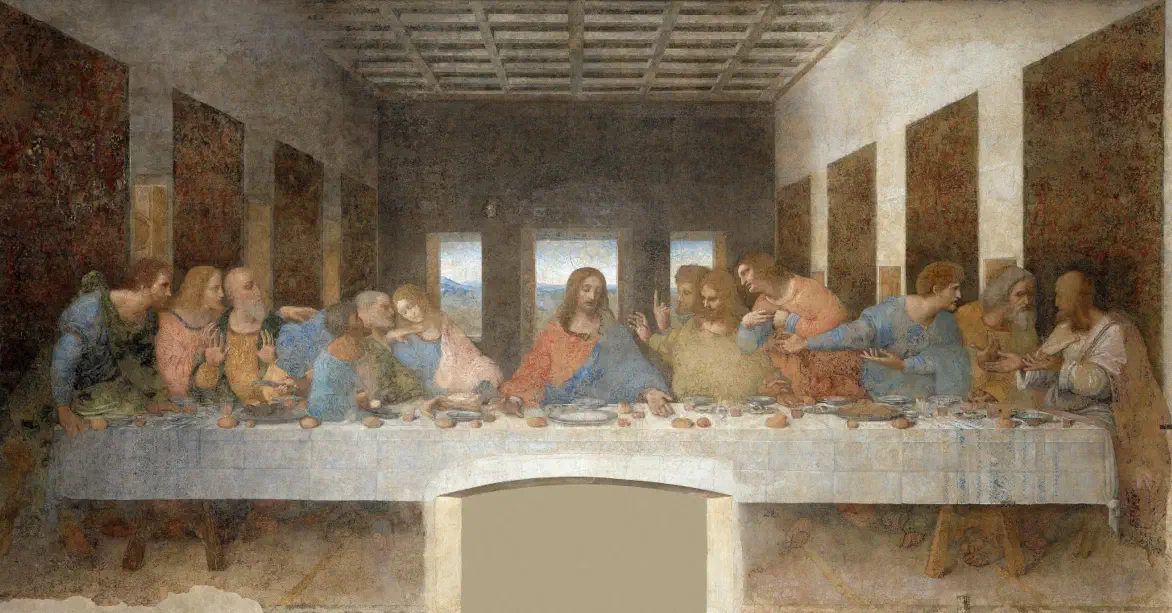
Jesus drank the fourth cup on the cross
The Last Supper was a Passover seder. The Mishnah, compiled around 200 AD from oral traditions that predate the destruction of the Temple, preserves the liturgical structure of the meal as first-century Jews practiced it. Jesus followed that structure. He blessed the bread and the wine with the standard berakhot, recited the Haggadah, sang the Hallel. He drank three of the four prescribed cups, refused the fourth at the table, and finished it on the cross.

The date question
John 18:28 says the Jewish leaders would not enter the Praetorium “lest they should be defiled; but that they might eat the passover” (John 18:28 ), and John 19:14 calls the day of the trial “the preparation of the passover” (John 19:14 ). Read against the Synoptics, this looks like a contradiction: did the crucifixion fall before or after the Passover meal? It falls after. “The passover” in Second Temple usage covered the entire festival week and its associated sacrifices, including the Chagigah peace offerings eaten on Nisan 15 (Deuteronomy 16:2 ; 2 Chronicles 35:7-9 ). “The preparation of the passover” is the Friday of Passover week: John uses παρασκευή three times in chapter 19 (verses 14, 31, 42), and in verses 31 and 42 it unmistakably means the day before the Sabbath. The Synoptics follow the liturgical calendar; John follows the typological line. Both accounts place the meal on Passover night.
The seder structure
The Mishnah tractate Pesachim, chapter 10, prescribes the Passover meal in detail. Even the poorest person in Israel must receive no fewer than four cups of wine (Pesachim 10:1). Each cup marks a stage in the liturgy:
| Cup | Mishnah | Liturgical moment |
|---|---|---|
| First | 10:2 | Kiddush, sanctification of the day |
| Second | 10:4-6 | Poured before the Maggid (telling); drunk after the first Hallel (Psalms 113-114) and the blessing of redemption |
| Third | 10:7 | Birkat Hamazon, grace after the meal |
| Fourth | 10:7 | Completion of Hallel (Psalms 115-118) and the blessing of song |
The Mishnah does not name the cups or explain why four. The Yerushalmi Pesachim 10:1 (37b) supplies the connection. The four cups correspond to four expressions of redemption in Exodus 6:6-7 :
| Cup | Hebrew | Expression | Verse |
|---|---|---|---|
| First | וְהוֹצֵאתִי v’hotzeiti | “I will bring you out” | 6:6a |
| Second | וְהִצַּלְתִּי v’hitzalti | “I will deliver you” | 6:6b |
| Third | וְגָאַלְתִּי v’ga’alti | “I will redeem you” | 6:6c |
| Fourth | וְלָקַחְתִּי v’lakachti | “I will take you to me for a people” | 6:7 |
A fifth expression follows in Exodus 6:8 : וְהֵבֵאתִי v’heveti, “I will bring you in.” The Talmud (Bavli Pesachim 118a) records R. Tarfon’s dispute about whether a fifth cup exists. In later tradition this becomes the Cup of Elijah, poured but not drunk, reserved for future redemption.
The required elements
Mishnah Pesachim 10:5 records Rabban Gamliel’s instruction: whoever has not explained three things has not fulfilled his obligation.
| Element | Hebrew | Role at the seder | Role at the cross |
|---|---|---|---|
| Pesach | פֶּסַח | The Passover lamb, slain and eaten | Jesus is the Passover lamb (1 Corinthians 5:7 ) |
| Matzah | מַצָּה | Unleavened bread, bread of affliction | “This is my body” (Luke 22:19 ) |
| Maror | מָרוֹר | Bitter herbs, remembering the bitterness of slavery | The vinegar (ὄξος , oxos) lifted to his mouth on the cross |
Pesachim 10:3 adds that the seder plate includes charoset and two cooked dishes. But the three elements Rabban Gamliel names are the ones the head of the household must explain. Each one reappears at the cross.
A fourth element belongs to the original Passover but not to the seder plate. Exodus 12:22 prescribes hyssop (אֵזוֹב , ezov) as the instrument for applying the lamb’s blood to the doorposts. John is the only gospel writer who names the plant used to deliver the sour wine to Jesus on the cross (John 19:29 ). Matthew and Mark record a reed (κάλαμος ). John records ὕσσωπος (hyssopos). The accounts are complementary: hyssop stalks are too short and flexible to reach a crucified man on their own, but bundled around a reed they form a serviceable handle, exactly as hyssop was bundled for sprinkling in the Levitical rites. Matthew and Mark name the structure; John names the plant. John names the one that ties the cross back to Exodus 12.
The blessings Jesus spoke
The gospels record that Jesus “gave thanks” (εὐχαριστήσας , eucharistēsas) over the bread and wine. The Greek maps directly to the Hebrew berakhot prescribed in Mishnah Berakhot 6:1.
Over bread, the HaMotzi:
בָּרוּךְ אַתָּה יְהוָה אֱלֹהֵינוּ מֶלֶךְ הָעוֹלָם הַמּוֹצִיא לֶחֶם מִן הָאָרֶץBaruch atah YHVH Eloheinu melech ha’olam, hamotzi lechem min ha’aretz. “Blessed are you, YHVH our God, King of the universe, who brings forth bread from the earth.”
Over wine, the HaGafen:
בָּרוּךְ אַתָּה יְהוָה אֱלֹהֵינוּ מֶלֶךְ הָעוֹלָם בּוֹרֵא פְּרִי הַגָּפֶןBaruch atah YHVH Eloheinu melech ha’olam, borei p’ri hagafen. “Blessed are you, YHVH our God, King of the universe, who creates the fruit of the vine.”
These are the words Jesus spoke when he took the bread and the cup. Matthew 26:26 uses εὐλογήσας (eulogēsas, “having blessed”) for the bread and εὐχαριστήσας (eucharistēsas, “having given thanks”) for the cup (Matthew 26:27). Both translate the Hebrew berakhah formula.
The remembrance redirected
At the Passover table, the head of the household recites what God did in Egypt. Mishnah Pesachim 10:5 records Rabban Gamliel’s instruction: whoever has not explained three things has not fulfilled his obligation. Pesach, the Passover offering. Matzah, the unleavened bread. Maror, the bitter herbs. The remembrance points backward to the Exodus. The same Passover that launched Israel out of Egypt launched the pattern that runs through Moses and Paul to Shavuot.
Jesus takes this liturgical moment and redirects it:
And he took bread, and gave thanks, and brake it, and gave unto them, saying, This is my body which is given for you: this do in remembrance of me. Likewise also the cup after supper, saying, This cup is the new testament in my blood, which is shed for you. (Luke 22:19-20 )
The bread is no longer the bread of affliction from Egypt. The wine is no longer the blood of the Passover lamb applied to the doorposts. He is the Passover lamb (1 Corinthians 5:7 ). The remembrance now points to him. His ministry lasted one year, Passover to Passover. The seder that began it is the seder he now completes.
The cup he identifies is the third cup, the Kos shel Berakhah, the Cup of Blessing, drunk after the meal with grace. Luke specifies: “the cup after supper.” Paul uses the identical name in 1 Corinthians 10:16 : “The cup of blessing which we bless, is it not the communion of the blood of Christ?” The Greek τὸ ποτήριον τῆς εὐλογίας (to potērion tēs eulogias) is a direct translation of the Hebrew liturgical term. Paul, a Pharisee trained under Gamaliel, knew exactly which cup he was naming.
Three cups drunk, one refused
The third cup is the only one the text identifies explicitly. Luke 22:20 specifies “the cup after supper,” and Paul names it the Cup of Blessing (1 Corinthians 10:16 ). The first two cups are not named in the gospels. That Jesus drank them is an inference from the seder structure: the Mishnah prescribes four cups as the required minimum, and Jesus followed the prescribed liturgy through the meal. He breaks from the sequence only at the fourth.
After the third cup, Jesus makes a declaration:
But I say unto you, I will not drink henceforth of this fruit of the vine, until that day when I drink it new with you in my Father’s kingdom. (Matthew 26:29 )
The fourth cup is the Kos shel Hallel, tied to the fourth expression of redemption: וְלָקַחְתִּי v’lakachti, “I will take you to me for a people” (Exodus 6:7 ). He leaves it on the table.
The hymn
And when they had sung an hymn, they went out into the mount of Olives. (Matthew 26:30 )
The hymn is the Hallel. Mishnah Pesachim 10:7 prescribes Psalms 115-118 after the meal, over the fourth cup. Jesus sang these psalms without drinking the cup that accompanies them.
The content of what he sang is worth reading slowly. Psalm 116:13 : “I will take the cup of salvation, and call upon the name of the Lord.” Psalm 116:15 : “Precious in the sight of the Lord is the death of his saints.”
Psalm 118:22 : “The stone which the builders refused is become the head stone of the corner.” Psalm 118:27 : “God is the Lord, which hath shewed us light: bind the sacrifice with cords, even unto the horns of the altar.”
He sang about binding the sacrifice to the altar. Then he walked to Gethsemane.
Gethsemane: the cup
O my Father, if it be possible, let this cup pass from me: nevertheless not as I will, but as thou wilt. (Matthew 26:39 )
The fourth cup is still unfinished. The seder is incomplete. He asks for it to pass. It does not pass.
The fourth cup on the cross
John records the final sequence with precision:
After this, Jesus knowing that all things were now accomplished, that the scripture might be fulfilled, saith, I thirst. Now there was set a vessel full of vinegar: and they filled a spunge with vinegar, and put it upon hyssop, and put it to his mouth. When Jesus therefore had received the vinegar, he said, It is finished: and he bowed his head, and gave up the ghost. (John 19:28-30 )
Three details close the seder.
The hyssop. Exodus 12:22 : “And ye shall take a bunch of hyssop, and dip it in the blood that is in the bason, and strike the lintel and the two side posts.” Hyssop is the instrument prescribed for applying the lamb’s blood to the doorposts at the first Passover. The same plant delivers the final cup to the Lamb at the last one.
The vinegar. Sour wine, ὄξος (oxos). He refused the fruit of the vine at the table. He receives it here. The fourth cup is drunk.
Tetelestai. Τετέλεσται (tetelestai), perfect passive indicative of τελέω (teleō). “It has been accomplished.” The perfect tense marks a completed action with ongoing results. The seder is finished. The four expressions of redemption are fulfilled. The fourth, “I will take you to me for a people,” is accomplished in his death. The Passover brought Israel out as a nation; the cross brings out a people from every nation. His death is the means of the ingathering.
What tetelestai does not mean
A popular teaching claims that tetelestai was stamped on ancient receipts meaning “paid in full.” The source is a set of Egyptian customs-tax receipts published by Grenfell and Hunt in 1896. The receipts contained the abbreviation τετελ , which they expanded as τετέλ(εσται) .
In 1934, the Berichtigungsliste der griechischen Papyrusurkunden (BL 1.188) corrected the reading. The word is τετελ(ώνηται) , the perfect passive of τελωνέω (telōneō, “to collect customs tax”), a different verb entirely. In all seventeen receipts where the scribe wrote the word out in full rather than abbreviating it, the word is τετελώνηται . Not once does τετέλεσται appear.
The parallel claim that tetelestai was written on criminal records when a sentence was served has no documented source. No papyrus, no inscription, no classical text supports it.
The verb τελέω can mean “to pay” in classical Greek, but only when paired with an explicit object: a tax (φόρος ), a duty (τέλος ), or a specific financial obligation. Used absolutely, without an object, as in John 19:30 , it means “it has been accomplished” or “it has been brought to completion” (LSJ, s.v. τελέω).
The meaning is not diminished by this correction. The word carries its full weight without the sermon illustration. In the context of the Passover seder, tetelestai marks the completion of a liturgical sequence that began in the upper room and ended on the cross. The four cups are drunk. The four expressions of redemption are fulfilled. The Passover lamb is slain.
References
- Mishnah, Pesachim 10:1-7: seder structure, four cups, Hallel sequence.
- Mishnah, Berakhot 6:1: prescribed blessings over bread and wine.
- Yerushalmi Pesachim 10:1 (37b): four cups linked to four expressions of redemption in Exodus 6:6-7.
- Babylonian Talmud, Pesachim 118a: R. Tarfon’s dispute on the fifth cup.
- Bernard P. Grenfell and Arthur S. Hunt, New Classical Fragments and Other Greek and Latin Papyri (1896), p. 79: original (incorrect) expansion of τετελ as τετέλ(εσται).
- Berichtigungsliste der griechischen Papyrusurkunden, vol. 1, p. 188 (1934): correction to τετελ(ώνηται).
- Aaron M. Jensen, “Does τετέλεσται Mean ‘Paid in Full’ in John 19:30?”, Wisconsin Lutheran Quarterly (2019): traces the exegetical urban legend.