

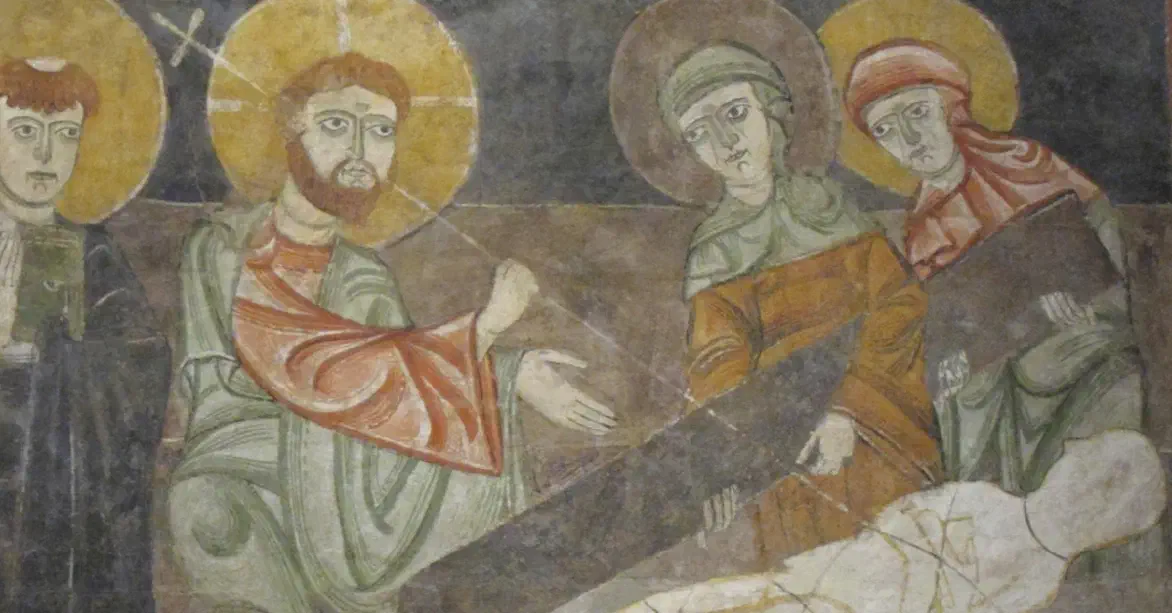
The messianic miracles in Isaiah and the gospels
When John’s disciples ask if Jesus is the Messiah, he does not say yes. He tells them to report what they see and hear (Luke 7:22 ). The list he gives corresponds to Isaiah. Every one of them does something no human had ever done before, and every one sends a message the Pharisees cannot miss.

John’s question
John the Baptist sends two disciples from prison with a question: “Art thou he that should come? or look we for another?” (Luke 7:19 ).
Jesus does not answer with a title or a claim. He answers with a list: “Go your way, and tell John what things ye have seen and heard; how that the blind see, the lame walk, the lepers are cleansed, the deaf hear, the dead are raised, to the poor the gospel is preached” (Luke 7:22).
It is Isaiah’s checklist for the Messiah.
The Isaiah checklist
| Sign | Isaiah | Text | Gospel | Fulfillment |
|---|---|---|---|---|
| Blind see | 35:5, 29:18 | “the eyes of the blind shall see” | John 9 | Man born blind |
| Lame walk | 35:6 | “the lame man leap as an hart” | Luke 5, Mark 2 | Paralytic walks |
| Deaf/dumb hear/speak | 35:5, 32:3-4 | “the ears of the deaf shall be unstopped… the tongue of the stammerers shall speak” | Mark 7:31-37 | Deaf-mute healed |
| Lepers cleansed | Matthew 8, Mark 1, Luke 5 | Leper cleansed | ||
| Dead raised | 26:19 | “Thy dead men shall live” | John 11 | Lazarus raised |
| Gospel preached | 61:1 | “to preach good tidings unto the meek” | All NT | The poor hear the gospel |
Every sign on the list is fulfilled publicly. But the details of how each one is performed carry a message that goes beyond the miracle itself.
No human had ever healed a leper
Leviticus 13-14 prescribes an elaborate purification ritual for healed lepers. The priests are given detailed instructions for inspecting the healed skin, preparing offerings, and pronouncing the person clean. The Mishnah tractate Negaim expands these laws extensively.
The procedure had essentially never been used. No Israelite was ever healed of tsara’at (צָרַעַת , leprosy) by a human being.
Miriam was struck with leprosy and healed by God directly in the wilderness (Numbers 12:10-15 ). This was before the Levitical system existed.
Naaman the Syrian was healed through Elisha (2 Kings 5). But Elisha never came out. He never touched Naaman. He never performed anything. He sent a messenger to tell Naaman to wash in the Jordan seven times. Naaman did, and was healed. Naaman himself acknowledged who did the healing: “Now I know that there is no God in all the earth, but in Israel” (2 Kings 5:15 ). YHWH healed Naaman. Elisha delivered instructions.
God heals lepers.
Jesus heals lepers directly (Matthew 8:3 , Mark 1:41 , Luke 5:13 ). He touches them. He speaks. They are clean. And then he sends every one of them to the priests: “Go thy way, shew thyself to the priest, and offer the gift that Moses commanded, for a testimony unto them” (Matthew 8:4 , Mark 1:44 , Luke 5:14 ).
As the Law requires. Leviticus 14. The priests receive a healed leper. They perform the purification ritual, possibly for the first time since the Law was given. And they must ask themselves who did this, because they know their own scriptures. They know that only God heals lepers.
No one had ever opened the eyes of a man born blind
Healing blindness caused by injury or disease is one thing. Healing a man born blind is another. Exodus 4:11 states plainly who is responsible for congenital blindness: “Who maketh the dumb, or deaf, or the seeing, or the blind? have not I the LORD?”
God causes it. Only God reverses it. No prophet, priest, or king in the history of Israel had ever opened the eyes of a man born blind. The healed man himself says it: “Since the world began was it not heard that any man opened the eyes of one that was born blind” (John 9:32 ).
Jesus does it in John 9 using saliva and clay. The method itself carries a separate claim (see John 8 and 9 are one confrontation). But the miracle alone, regardless of method, is something the Pharisees know has never happened before.
No exorcist could cast out a mute demon
The standard exorcism procedure in the first century required knowing the demon’s name. The exorcist would command the spirit by name to leave. This is why Jesus asks “What is thy name?” in the encounter with Legion (Mark 5:9 ).
A deaf and mute person cannot participate in this process. They cannot hear the exorcist. They cannot speak the demon’s name. By every standard the Pharisees recognized, casting out a demon from a deaf-mute was impossible.
Jesus does it. “Thou dumb and deaf spirit, I charge thee, come out of him, and enter no more into him” (Mark 9:25 ). He does not need the person to speak the name. He does not need the demon to identify itself. He gives the command directly and it obeys.
No exorcist in Israel could do this. The Pharisees knew why.
Lazarus and the fourth day
Jewish tradition held that the soul hovers over the body for three days after death, hoping to return. After three days, decomposition begins and the soul departs permanently. A person dead three days might still return. A person dead four days is beyond recovery by any measure.
Jesus is told that Lazarus is sick (John 11:3 ). He waits two more days before departing (John 11:6 ). By the time he arrives, Lazarus has been dead four days (John 11:17 ).
This is deliberate. He does not arrive on day two or day three when the tradition still allows hope. He waits until day four, past every natural and traditional threshold. Martha confirms: “Lord, by this time he stinketh: for he hath been dead four days” (John 11:39 ).
He then raises Lazarus in front of witnesses. Not someone who might have been in a coma. Not someone who might have been in a deep sleep. A man four days dead, decomposing, past the point the Jewish tradition considers final.
The Pharisees knew
Who is performing them is the message.
The Pharisees know Isaiah. They read it in the synagogue. Jesus reads Isaiah 61 publicly in Luke 4 and declares it fulfilled. Every miracle on the Isaiah checklist is performed in public, in front of witnesses, using methods that their own tradition says only God or his Messiah can use.
They are confronted by it.
Rabbinic tradition
The idea about three messianic miracles is often discussed in teaching, but the exact sources in rabbinic literature are scattered and indirect. The Babylonian Talmud does not contain a single passage listing all three together. Instead, different discussions contribute to the concept.
- Healing a leper: Babylonian Talmud, tractate Sanhedrin 98a .
- Casting out a mute demon: Babylonian Talmud, tractate Gittin 68b .
- Healing a man born blind: Babylonian Talmud, tractate Sanhedrin 93b .
References
- Mishnah, tractate Negaim: laws governing the inspection and purification of leprosy.
- Babylonian Talmud, Sanhedrin 98a: healing a leper classified as a messianic sign.
- Babylonian Talmud, Gittin 68b: casting out a mute demon as a messianic sign.
- Babylonian Talmud, Sanhedrin 93b: healing a man born blind as a messianic sign.