

The one year ministry of Jesus
Jesus’ ministry lasted one year, Passover to Passover. The 3.5-year tradition depends entirely on a single verse, John 6:4 , that the earliest church fathers did not have in their text. Without it, John’s gospel follows one complete cycle through the biblical feasts. Every major event in that year maps to the feast calendar as a campaign in the war announced in Genesis 3:15 .

The 3.5-year ministry has one source
Remove the gospel of John and nothing in Matthew, Mark, or Luke suggests a ministry longer than one year. Mark reads as consecutive events with no multi-year gaps. The entire 3.5-year framework comes from counting Passovers in John. Three Passovers would mean at least two full years. The third Passover comes from John 6:4: “And the passover, a feast of the Jews, was nigh.”
If that verse is original, Jesus attended three Passovers and his ministry lasted approximately 3.5 years. If it is a scribal insertion, John records two Passovers (2:13 and 13:1) and the ministry is one year.
John 6:4 was not in the early text
Irenaeus of Lyons (c. 130-202 AD) was a disciple of Polycarp, who was a disciple of the apostle John. In Against Heresies Book II, Chapter 22, Sections 3-6, he counts exactly three Passovers in John’s gospel:
- John 2:23 , after the wedding at Cana
- John 5, where he identifies the healing of the paralytic as a second Passover visit to Jerusalem
- John 12:1 , the final Passover before the crucifixion
He does not count a Passover at John 6:4. If that verse existed in his manuscript, he had a Passover readily available and would not need to argue that John 5 must be one. He labors to turn an unnamed feast into a Passover while ignoring an explicit one a single chapter later. His text did not contain it.
The one-year ministry was the earlier position. Clement of Alexandria cited Isaiah 61:2 , “the acceptable year of the Lord,” as the duration (Stromata 1.21). Tertullian, Origen, and Julius Africanus all held the same position. None of them reference a Passover at John 6:4. If their texts contained an explicit Passover at that location, a one-year ministry would be impossible to argue.
The 3.5-year ministry became standard in the 4th century through Eusebius of Caesarea, who harmonized the timeline with Daniel 9:27 , “in the midst of the week.”
Greek manuscript evidence: minuscule 472 (13th century) marks John 6:4 with obelisks indicating doubt. Minuscule 1634 (14th century) omits it entirely.
The feeding of the 5,000 disqualifies Passover
This is the only event recorded in all four gospels. The details are specific and they rule out Passover.
Barley loaves. The boy carries barley loaves (John 6:9 ). Barley bread is leavened. Passover requires unleavened bread (Exodus 12:15 ). Eating and distributing leavened bread during Passover is a direct violation of the Law.
No Jerusalem. Passover is one of three pilgrimage feasts requiring attendance in Jerusalem (Deuteronomy 16:16 ). Jesus is in Galilee with a multitude. After the feeding he crosses the sea to Capernaum (John 6:17 ), moving further north.
No sin offerings. If Jesus ate and distributed leavened bread during Passover and was absent from Jerusalem, he violated the Law on multiple counts. That would disqualify him as Messiah and require sin offerings. The text records none. None were required because it was not Passover.
Mark’s pacing. Mark’s gospel moves from event to event with the word euthys (εὐθύς , “immediately, straightway”) appearing over 40 times. A Passover at John 6:4 forces month-long silences into a narrative that reads as consecutive days and weeks.
Green grass. Mark 6:39 records that Jesus commanded them to sit on the green grass. Grass is green in Galilee in early fall after the summer heat breaks, consistent with Yom Teruah (Sep/Oct).
The feast calendar in John
John structures his gospel around one complete annual cycle of the biblical feasts. With John 6:4 removed, the pattern is unbroken.
| Feast | Hebrew month | Modern | John | Event |
|---|---|---|---|---|
| Passover | Nisan | Mar/Apr | 2:13 | Temple cleansing, ministry begins |
| Shavuot | Sivan | May/Jun | 5:1 | Unnamed feast, healing at the pool |
| Yom Teruah | Tishri 1 | Sep/Oct | 6 | Feeding of the 5,000 |
| Yom Kippur | Tishri 10 | Sep/Oct | The Lamb God provides (Genesis 22:8 , John 1:29 ) | |
| Sukkot | Tishri 15 | Sep/Oct | 7:2 | “If any man thirst, let him come unto me, and drink” |
| Hanukkah | Kislev | Nov/Dec | 10:22 | “I and my Father are one” |
| Passover | Nisan | Mar/Apr | 13:1 | The final Passover, crucifixion |
One year.
The acceptable year
In Luke 4:18-19 , Jesus reads Isaiah 61 in the synagogue at Nazareth: “The Spirit of the Lord is upon me, because he hath anointed me to preach the gospel to the poor; he hath sent me to heal the brokenhearted, to preach deliverance to the captives, and recovering of sight to the blind, to set at liberty them that are bruised, to preach the acceptable year of the Lord.”
Shanah (שָׁנָה , “year”). Singular.
He closes the scroll, gives it to the minister, and sits down (Luke 4:20 ). The people are astonished. In synagogue practice, the teacher sits to teach from the position of authority. Matthew 23:2 identifies this seat: “The scribes and the Pharisees sit in Moses’ seat” (καθέδρας Μωϋσέως ). Jesus sat in that seat and said, “This day is this scripture fulfilled in your ears” (Luke 4:21 ).
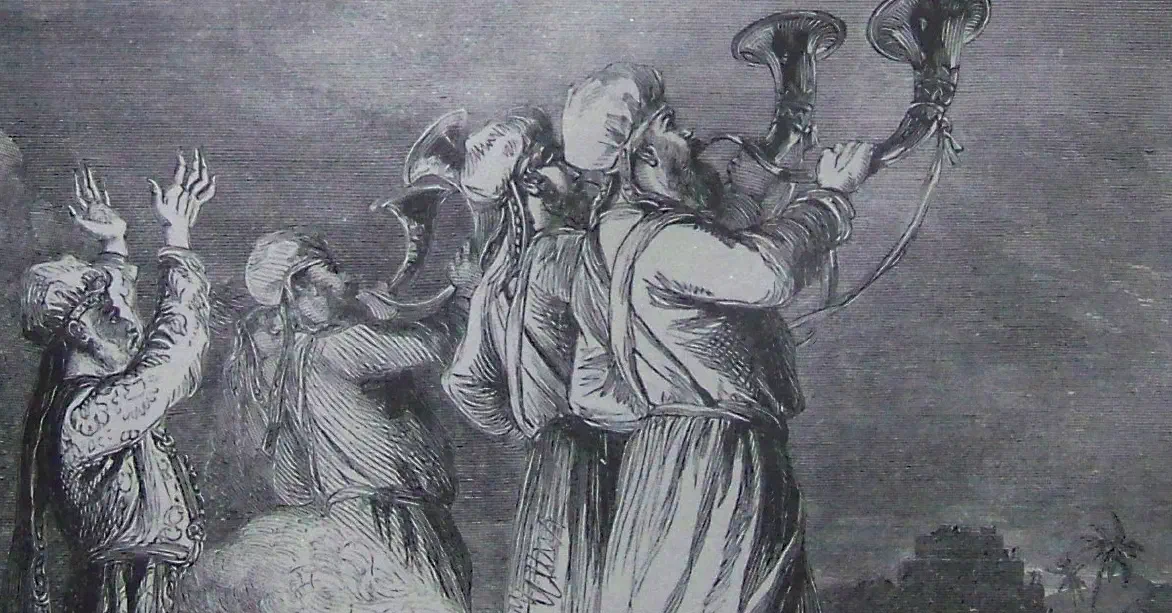
The acceptable year is the Jubilee year. The trumpet that inaugurates the Jubilee is blown on the Day of Atonement: “Then shalt thou cause the trumpet of the jubile to sound on the tenth day of the seventh month, in the day of atonement shall ye make the trumpet sound throughout all your land” (Leviticus 25:9 ). The Hebrew teruah (תְּרוּעָה , “trumpet blast”) gives Yom Teruah its name. The King is inaugurated. The Jubilee year begins.
The campaign
Genesis 3:15 announces the war: “I will put enmity between thee and the woman, and between thy seed and her seed; it shall bruise thy head, and thou shalt bruise his heel.”
Jesus’ one-year ministry is the campaign.
Reconnaissance. In the desert, Satan tests three times. Each opens with “If thou be the Son of God” (Matthew 4:3 , 4:6). It is intelligence gathering. The third test quotes Psalm 91:11-12 , the messianic promise of angelic protection. Satan is probing whether this is the seed of the woman.
Inauguration. Isaiah 61. Moses’ seat. “This day is this scripture fulfilled.” The King announces his authority.
12 sent out. Jesus sends twelve disciples into the land (Luke 9:1-6 ). Twelve spies, the same number Moses sent into Canaan (Numbers 13:1-16 ).
70 sent out. Jesus sends seventy into every city and place (Luke 10:1 ). Seventy nations in Genesis 10. The Deuteronomy 32 framework: God divided the nations according to the number of the sons of God (Deuteronomy 32:8 , LXX) and reserved Israel as his own inheritance. Jesus sends one representative per nation. He is reclaiming the territory.
Satan falls. The seventy return and report that even the devils are subject to them. Jesus responds: “I beheld Satan as lightning fall from heaven” (Luke 10:18 ). The campaign is working.
The lamb, the gardener, and the wave offering
The final events of the ministry fulfill the remaining feasts.
| Feast | Modern | Event | Reference |
|---|---|---|---|
| Passover | Mar/Apr | Jesus is the Passover lamb, slain | John 1:29, 1 Corinthians 5:7 |
| Yom Kippur (fulfillment) | Sep/Oct | The Lamb God provides for Abraham | Genesis 22:8 |
| First Fruits | Mar/Apr | Mary sees a “gardener” | John 20:15 |
| First Fruits | Mar/Apr | “Touch me not, for I am not yet ascended” | John 20:17 |
| After presentation | Thomas touches him. The wave offering is accepted | John 20:27 |
Mary Magdalene comes to the tomb and sees a man she supposes to be the gardener (John 20:15). The first Adam was placed in a garden to tend it (Genesis 2:15 ). The last Adam (1 Corinthians 15:45 ) appears in a garden as a gardener. This is First Fruits. The day the first sheaf of the harvest is cut and presented.
Jesus tells her, “Touch me not; for I am not yet ascended to my Father” (John 20:17). He is the wave offering (Leviticus 23:11 ), not yet presented. After he ascends and presents himself to the Father, Thomas touches him (John 20:27). The offering has been accepted. The counting of the Omer begins.
References
- Irenaeus of Lyons, Against Heresies (Adversus Haereses), II.22.3-6: counted three Passovers in John without using John 6:4; argued John 5:1 must be Passover.
- Clement of Alexandria, Stromata 1.21: cited Isaiah 61:2 as the duration of the ministry, one year.
- Tertullian, Against the Jews (Adversus Iudaeos), ch. 8: one-year ministry consistent with the Daniel 9 timeline.
- Julius Africanus, Chronographiae: one-year ministry within biblical chronology.
- Eusebius of Caesarea, Historia Ecclesiastica (Ecclesiastical History): established the 3.5-year framework harmonized with Daniel 9:27.
- Greek NT minuscule 472 (13th c.) and minuscule 1634 (14th c.): manuscript evidence marking or omitting John 6:4.