

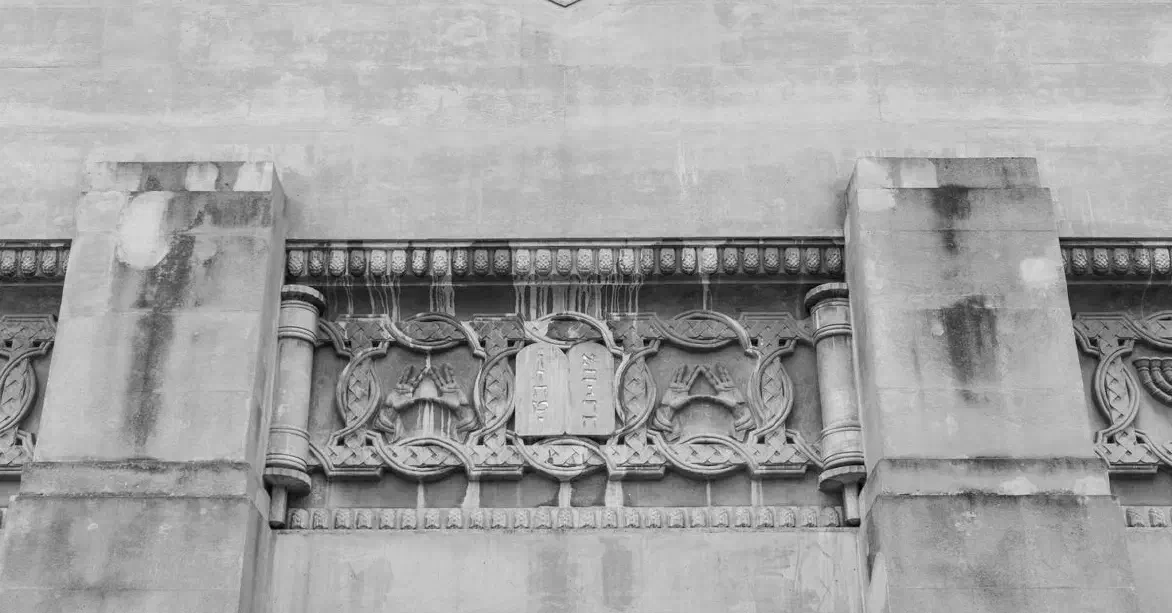
The temple signs stopped forty years before the destruction
The Babylonian Talmud records that for the last forty years before the temple’s destruction, the four annual signs of Yom Kippur failed every year: the lot stopped favoring the right hand, the crimson thread stopped turning white, the western lamp went out, and the temple doors opened by themselves. The temple fell in 70 AD; forty years before is 30 AD. The source is the tradition that rejected Jesus, recording the failure of its own atonement signs from the year of the crucifixion onward.

The Yom Kippur mechanics
Leviticus 16 prescribes the Day of Atonement. Two goats are presented, and lots are cast over them:
And Aaron shall cast lots upon the two goats; one lot for the LORD, and the other lot for the scapegoat. Leviticus 16:8 KJV
One goat is sacrificed. The other, the goat for Azazel (עֲזָאזֵל ), carries the sins of Israel into the wilderness (Leviticus 16:21-22 ). The high priest draws the two lots, one in each hand. The lot inscribed “for the LORD” (לַשֵּׁם , lashem, “for the Name”) coming up in the right hand was taken as the sign of acceptance.
A strap of crimson wool belonged to the same ritual. The Talmud (Yoma 67a) describes it divided: half tied to the rock where the scapegoat was driven off, half between the goat’s horns. Mishnah Yoma 6:8 records a strip tied to the entrance of the Sanctuary, turning white when the goat reached the wilderness, read through the prophets:
Come now, and let us reason together, saith the LORD: though your sins be as scarlet, they shall be as white as snow; though they be red like crimson, they shall be as wool. Isaiah 1:18 KJV
Crimson wool turning white meant the atonement was accepted.
What Yoma 39b records
The baraita in Yoma 39b:
Our Rabbis taught: During the last forty years before the destruction of the Temple, the lot did not come up in the right hand; nor did the crimson-coloured strap become white; nor did the westernmost light shine; and the doors of the Hekal would open by themselves, until Rabban Yochanan ben Zakkai rebuked them, saying: Hekal, Hekal, why wilt thou be the alarmer thyself? I know about thee that thou wilt be destroyed, for Zechariah ben Ido has already prophesied concerning thee: Open thy doors, O Lebanon, that the fire may devour thy cedars. Babylonian Talmud, Yoma 39b (Soncino)
Four signs, one time span:
| Sign | Meaning when working | For the last forty years |
|---|---|---|
| The lot for the LORD in the right hand | Atonement accepted | Never came up right |
| Crimson strap turns white | Sins carried away (Isaiah 1:18) | Stayed crimson |
| Westernmost lamp of the menorah stays lit | The continual light tended | Went out |
| Sanctuary doors | Closed and kept | Opened by themselves |
The same tractate (Yoma 39a) records the contrast case: during the forty years Shimon HaTzaddik served as high priest, the lot always came up in the right hand and the thread always whitened.
The Jerusalem Talmud (Yoma 6:3) carries the parallel tradition.
The arithmetic
The temple was destroyed in Av of 70 AD. The Talmud’s own figure, forty years, places the beginning of the failure at 30 AD, the crucifixion year under the one-year ministry.
The lot alone makes the point. Two lots, one in each hand, drawn blind. The chance of the left hand forty years in succession is one in 2^40, roughly one in a trillion. The Talmud presents this as the temple alarming itself, and has Yochanan ben Zakkai answer the doors with Zechariah 11:1 , a prophecy of the sanctuary burning.
The torn veil, same window
The gospels record their own temple sign at the moment the window opens:
And, behold, the veil of the temple was rent in twain from the top to the bottom; and the earth did quake, and the rocks rent. Matthew 27:51 KJV
From that Passover forward, on the accounting of Yoma 39b, no Yom Kippur was accepted again.
Hebrews states the doctrine the signs enact:
But this man, after he had offered one sacrifice for sins for ever, sat down on the right hand of God. Hebrews 10:12 KJV
Josephus and the doors
Josephus, writing for a Roman audience and no friend of the Jesus movement, lists portents before the war (Wars 6.5.3). Among them: the eastern gate of the inner court, made of brass and so heavy that twenty men were needed to shut it, “was seen to be opened of its own accord about the sixth hour of the night” during Passover. The learned, he says, understood it to mean “that the security of their holy house was dissolved of its own accord, and that the gate was opened for the advantage of their enemies.”
Josephus dates his portents to the years around the war’s outbreak, so his testimony is independent of the rabbinic forty-year tradition. What the two witnesses share is the sign itself and its reading: doors that open themselves announce the coming destruction.
The weight of a hostile witness
The Talmud is the literature of the tradition that rejected the messianic claim. It preserves the ben Pandera polemic (the illegitimacy accusation) and has no motive to hand Christians an argument. Yet it records, in plain ritual bookkeeping, that the atonement machinery of Israel returned “not accepted” every year from 30 AD until the destruction.
References
- Babylonian Talmud, Yoma 39b: the four signs failing during the last forty years before the destruction; Yochanan ben Zakkai and Zechariah 11:1.
- Babylonian Talmud, Yoma 39a: the signs functioning during the forty years of Shimon HaTzaddik.
- Babylonian Talmud, Yoma 67a: the crimson strap divided at the scapegoat ritual; Mishnah Yoma 6:8: the strip at the Sanctuary entrance turning white as the goat reached the wilderness.
- Jerusalem Talmud, Yoma 6:3: parallel tradition of the signs’ failure.
- Josephus, Wars of the Jews 6.5.3: portents before the war, including the self-opening eastern gate.