

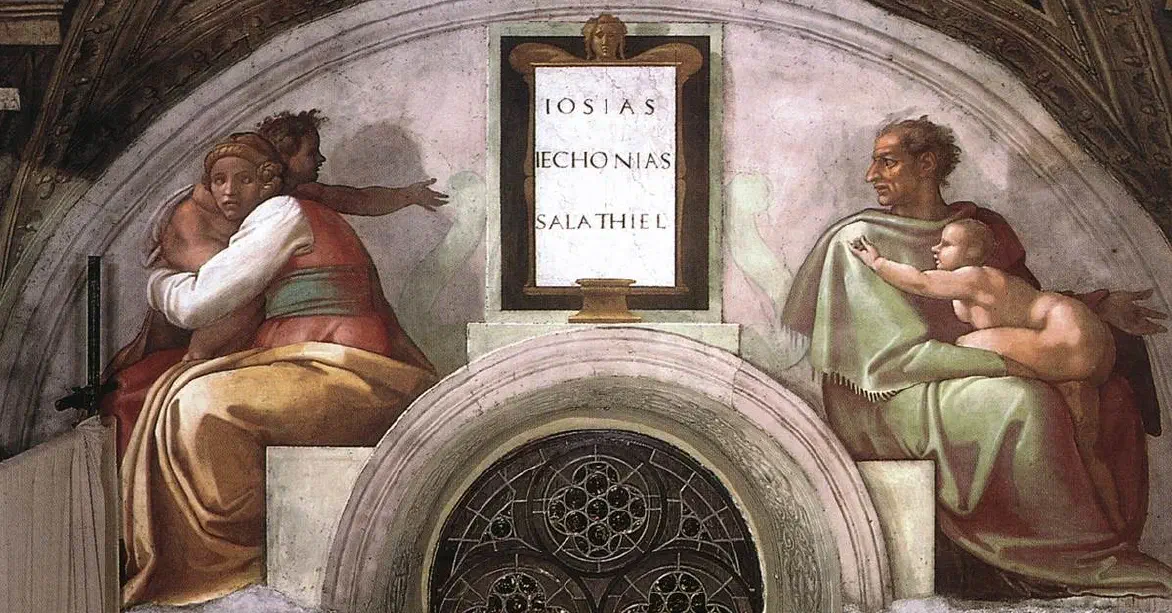
The virgin birth was the only way to legally place Jesus on David's throne
The virgin birth solves a legal problem. Matthew’s genealogy traces Joseph’s line through Solomon and through Jeconiah, who was cursed by God in Jeremiah 22:30. No descendant of Jeconiah shall sit on David’s throne. Luke’s genealogy traces Mary’s line through Nathan, David’s other son, bypassing Jeconiah entirely. The virgin birth is the only mechanism that gives Jesus legal right to the throne through Joseph without inheriting the blood curse through Joseph.

The curse
Thus saith the Lord, Write ye this man childless, a man that shall not prosper in his days: for no man of his seed shall prosper, sitting upon the throne of David, and ruling any more in Judah. Jeremiah 22:30 KJV
“This man” is Coniah (Jeconiah), king of Judah. The curse is specific: no biological descendant of Jeconiah will sit on David’s throne. Jeconiah had sons (1 Chronicles 3:17-18 ). They lived, they had children, but the royal line through Solomon was permanently disqualified from the throne by God’s own decree.
Two genealogies
Matthew and Luke both trace a line from David to Jesus. They serve different purposes and run through different sons of David.
| Matthew 1 (Joseph) | Luke 3 (Mary) | |
|---|---|---|
| From | Abraham → Jesus | Adam → Jesus |
| Son of David | Solomon | Nathan |
| Roboam | Mattatha | |
| … | … | |
| Jeconiah | (no Jeconiah) | |
| Salathiel | Neri | |
| Zorobabel | … | |
| … | Heli | |
| Ends at | Joseph (husband of Mary) | Joseph (son-in-law of Heli) |
| Function | Legal right to throne | Blood descent from David |
Matthew 1:16 reads: “And Jacob begat Joseph the husband of Mary, of whom was born Jesus, who is called Christ.” The phrase shifts. Every prior entry says “begat.” At Joseph, it says “husband of Mary, of whom was born Jesus.” Matthew marks the biological break in his own text.
Luke 3:23 reads: “being (as was supposed) the son of Joseph, which was the son of Heli.” The parenthetical “(as was supposed)” flags the same point. Joseph is the legal father, not the biological one. Heli is Mary’s father. Joseph is “the son of Heli” by marriage, the standard convention when a man had no sons.
The two lines converge at David and diverge immediately at his sons. Solomon carries the royal succession and the curse. Nathan carries the blood without the curse.
Three requirements
For Jesus to be the promised Messiah, three conditions must be met simultaneously:
Legal heir to David’s throne. The promise to David (2 Samuel 7:12-13 ) requires a son to sit on his throne. The legal line of succession runs through Solomon. Joseph carries this line (Matthew 1).
Biological descendant of David. The Messiah must be the “seed of David” (Romans 1:3 ), a physical descendant. Mary carries this through Nathan’s line (Luke 3).
Free of Jeconiah’s curse. No biological descendant of Jeconiah shall reign (Jeremiah 22:30). Joseph descends from Jeconiah. Any biological son of Joseph inherits the curse.
A biological son of Joseph satisfies #1 and #2 but fails #3. A son with no connection to Joseph satisfies #3 but fails #1. The virgin birth is the only arrangement that satisfies all three. Jesus inherits the legal right through Joseph without inheriting the cursed blood through Joseph.
Only begotten
John 3:16 calls Jesus the μονογενής (monogenes), the “only begotten Son.” The word means the only one generated from that source. If Joseph or any other human male were the biological father, the term is false. God cannot be the sole generator of a son who has a human father. Monogenes requires the virgin birth to be literally true.
The ben Pandera claim (Talmud, Toledot Yeshu) attempts to replace the virgin birth with an illegitimate human father. If that were true, Jesus is neither monogenes (because God did not generate him alone) nor a legal heir through Joseph (because Joseph would have no reason to claim a child that was not his and was not divinely conceived). The claim destroys both the theological and legal standing it tries to undermine.
Begotten son, adopted sons
Paul distinguishes between Jesus’ sonship and the believer’s sonship with a specific legal term. In Romans 8:15, Galatians 4:5, and Ephesians 1:5, he uses υἱοθεσία (huiothesia): adoption as sons. Believers enter God’s family by adoption. Jesus enters by generation.
For ye have not received the spirit of bondage again to fear; but ye have received the Spirit of adoption, whereby we cry, Abba, Father. Romans 8:15 KJV
The distinction is deliberate. If Jesus were Joseph’s biological son, his relationship to God would also be adoptive. He would be a human son adopted into divine sonship, the same category as every believer. The entire framework Paul builds (natural son vs. adopted sons) collapses without the virgin birth.
Through Mary, every human who shares Adamic descent is a distant biological relative of Jesus. The bloodline is real. But biological relation and legal standing are different categories. Jesus holds sonship by birth. Believers hold it by adoption. The virgin birth is what keeps the two categories distinct.
References
- Babylonian Talmud and Toledot Yeshu: the ben Pandera claim as an alternative paternity tradition.